
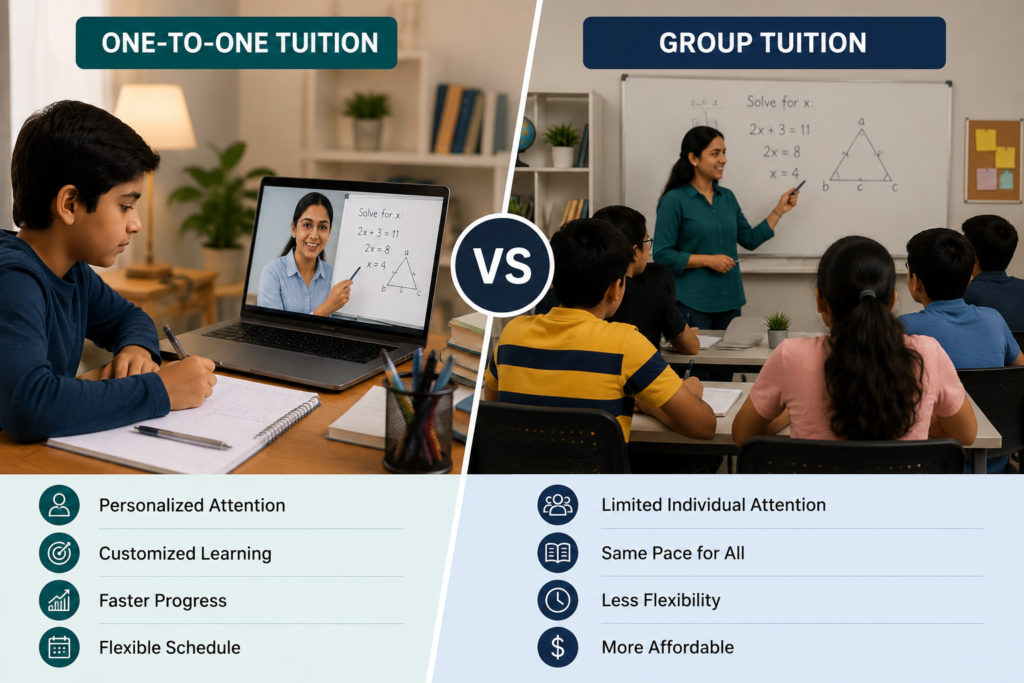
Choosing between one-to-one tutoring and group online tuition can be difficult when you simply want the best support for your child. Both formats can help students learn, practice and prepare for exams. However, they work differently, and the better choice often depends on your child’s confidence, learning pace, academic needs and personality.
Some students ask questions freely and enjoy learning with other children. Others need more time, more explanation or individual attention before they feel comfortable moving ahead. Therefore, before choosing a tutoring format, it helps to understand what your child actually needs.
In this guide, we will compare one-to-one tutoring and group tuition across attention, flexibility, confidence, interaction, learning pace and overall fit for different students.

What Is One-to-One Tutoring?
One-to-one tutoring means a tutor works with one student during the learning session. The lesson can therefore be adjusted around the student’s current understanding, questions, pace and academic goals.
For example, if a student is struggling with fractions, the tutor can spend additional time on the basics instead of moving ahead because other students are ready for the next topic.
This can be especially helpful when a child has specific learning gaps, needs regular individual feedback or finds it difficult to ask questions in front of other students.
What Is Group Online Tuition?
Group online tuition involves one tutor teaching two or more students during the same session. Depending on the class size, students may ask questions, participate in discussions and learn from the questions raised by their classmates.
For some students, this creates an enjoyable learning environment. It can also encourage participation, discussion and peer interaction.
However, the amount of individual attention may vary depending on the size of the group and the teaching approach.
One-to-One Tutoring vs Group Tuition: At a Glance
| Factor | One-to-One Tutoring | Group Tuition |
|---|---|---|
| Individual attention | Very high | Depends on group size |
| Learning pace | Highly flexible | Shared pace |
| Personalized lessons | Strong | Moderate to high |
| Student interaction | Direct tutor interaction | Peer interaction included |
| Question time | More individual space | Shared among students |
| Best for targeted learning gaps | Often suitable | Depends on the group |
| Peer learning | Limited | More opportunities |
1. Which Format Gives Your Child More Individual Attention?
If individual attention is your biggest priority, one-to-one tutoring has a clear advantage.
The tutor can notice where the student is struggling, ask follow-up questions and change the explanation when the first approach does not work.
Imagine your child understands 80 percent of a topic but is confused about one important step. In a one-to-one lesson, the tutor can spend time on that exact point instead of following a group schedule.
In a group class, the tutor needs to balance the needs of several students. That can still work well, especially in a small group, but the amount of individual attention may be different.
2. Which One Works Better for Different Learning Speeds?
Children do not all learn at the same speed.
One student may understand a math concept after one example. Another may need three examples and additional practice before feeling confident.
This is where one-to-one tutoring can be particularly useful. The tutor can slow down when necessary or move forward when the student is ready.
Group classes generally need a shared pace. A good tutor can still adapt activities and explanations, but the class has to move together to some extent.

3. What About Student Confidence?
Confidence can influence how actively a child participates in learning.
Some students are naturally comfortable speaking in front of others. They raise their hands, answer questions and learn well through discussion.
Other students hesitate. They may know the answer but avoid speaking because they are worried about making a mistake.
For a quieter learner, one-to-one tutoring can create a more comfortable space to ask questions without worrying about what other students may think.
On the other hand, a supportive small group can also help some students build communication and participation skills.
4. Which Format Is Better for Learning Gaps?
Suppose a Grade 8 student is struggling with algebra because some Grade 6 and Grade 7 concepts were never fully understood.
Moving forward with the current syllabus may only make the problem worse.
In this situation, one-to-one tutoring can make it easier to identify the exact learning gap and create a targeted practice plan.
A group class can also provide support, particularly if several students have similar difficulties. However, when the learning gap is very specific to one child, individual attention may be more practical.
5. Which Option Encourages More Peer Interaction?
This is one area where group learning can have an advantage.
Students can hear different questions, compare approaches and learn from the explanations given to their classmates. For some children, that social interaction makes learning more enjoyable.
Group tuition can therefore be a good fit for students who enjoy collaborative learning and are comfortable participating in a shared class environment.
However, if your child becomes distracted easily or rarely participates in group discussions, one-to-one tutoring may provide a more focused environment.
6. What About Flexibility?
Parents often have busy schedules, and students may have school, sports, activities and examination preparation competing for their time.
Depending on the tutoring provider, one-to-one tutoring may make it easier to arrange sessions around the student’s availability and learning priorities.
Group sessions usually have fixed schedules because several students need to attend at the same time.
Therefore, flexibility can become an important factor for families managing a busy timetable.
7. Is Group Tuition Always Less Expensive?
Cost is naturally part of the decision.
Group tuition may sometimes cost less per student because the tutor is teaching several learners during the same session. However, pricing varies widely between providers, class sizes and course formats.
Instead of comparing price alone, think about the value your child actually needs.
If your child mainly needs occasional reinforcement and enjoys learning with peers, group tuition may be enough. If your child has significant learning gaps and needs frequent individual feedback, one-to-one tutoring may offer a better match for the situation.
8. Which Format Is Better for Exam Preparation?
There is no single answer.
For a student who needs a structured revision schedule, group tuition can provide a clear programme and shared practice.
However, a student who has a few specific weak areas may benefit more from one-to-one tutoring, because the tutor can spend additional time exactly where it is needed.
So, rather than asking which format is universally better, ask which format matches the student’s current preparation needs.
Which Students May Benefit Most From One-to-One Tutoring?
One-to-one tutoring may be a particularly useful option when a student:
- Has noticeable learning gaps
- Needs a slower or faster learning pace
- Is struggling in one specific subject
- Needs frequent individual feedback
- Feels uncomfortable asking questions in groups
- Needs a customized study plan
- Is preparing for an important examination
- Needs focused support to rebuild confidence
Which Students May Prefer Group Online Tuition?
Group tuition may work well for a child who:
- Enjoys learning with other students
- Is comfortable asking questions in a group
- Does not require intensive individual support
- Likes discussion and peer interaction
- Can keep up with a shared learning pace
- Benefits from structured group practice
How Parents Can Make the Right Choice
Instead of asking, “Which one is better?”, ask, “Which one is better for my child?”
Start with your child’s needs. Then consider learning pace, confidence, subject difficulty, schedule, interaction preferences and the level of individual attention required.
- Choose one-to-one tutoring when individual attention and targeted support are the priority.
- Choose group tuition when your child enjoys shared learning and can work comfortably at a common pace.
- Consider a small group when you want some peer interaction without a very large class.
Questions to Ask Before Enrolling
- How many students are included in a group?
- How much individual attention will my child receive?
- Can the tutor adapt the pace?
- How are learning gaps identified?
- How is progress tracked?
- Can parents receive regular feedback?
- Is a demo class available?
- Can the tutoring schedule fit around school and other activities?
How EduEnrich Global Approaches Personalized Learning
At EduEnrich Global, personalized online tutoring is designed around the student’s academic needs, curriculum and learning goals.
The platform currently supports students in Grades 3–12 across CBSE, ICSE, IB and Cambridge curricula, with features such as tutor matching, one-to-one learning, personalized learning plans, flexible scheduling and progress tracking. Explore EduEnrich Global.
This means parents do not have to choose a tutoring format based only on what sounds popular. Instead, they can discuss the child’s requirements and explore the type of academic support that fits those needs.

A Simple Parent Decision Guide
Use these questions to make the decision easier:
- Does my child need intensive individual attention? Consider one-to-one tutoring.
- Does my child enjoy learning with peers? A group class may work well.
- Does my child have a specific learning gap? Individual support may be more suitable.
- Does my child become nervous in groups? One-to-one learning may create a more comfortable environment.
- Does my child learn well through discussion? Group tuition may offer useful peer interaction.
- Does our family need schedule flexibility? Compare the actual session timings before deciding.
Final Thoughts
There is no universal winner in the one-to-one tutoring versus group tuition debate.
For one child, individual attention may be exactly what is needed to rebuild confidence and close learning gaps. For another, a supportive group may provide motivation, discussion and a comfortable learning environment.
The best decision comes from understanding your child’s actual needs rather than choosing based only on cost, popularity or convenience.
Take a close look at how your child learns, ask the right questions and use a demo session whenever possible. Once the learning format matches the student, tutoring becomes much more useful.
Frequently Asked Questions
Is one-to-one tutoring better than group tuition?
It depends on the student. One-to-one tutoring offers more individual attention, while group tuition can provide peer interaction and shared learning. The better choice depends on the child’s needs, confidence and learning style.
Who benefits most from one-to-one tutoring?
Students with specific learning gaps, subject difficulties, confidence issues or a strong need for individual feedback may benefit from one-to-one tutoring.
Is group online tuition good for school students?
Yes, group online tuition can work well for students who enjoy collaborative learning, participate comfortably and can follow a shared lesson pace.
Does one-to-one tutoring cost more than group tuition?
It can cost more per session because the tutor is working individually with one student, but prices vary by provider, tutor experience, subject and programme. Parents should compare value as well as price.
Can a tutor switch between individual and group learning?
Some tutoring providers offer different formats, while others specialize in one. Ask about available options and choose the format that best matches the student’s current needs.
Should parents try a demo before choosing tutoring?
Yes. A demo can help parents and students understand the teaching style, level of interaction and overall fit before making a longer-term decision.
Ready to Find the Right Learning Format for Your Child?
If you are comparing one-to-one tutoring and group online tuition, EduEnrich Global can help you explore personalized academic support based on your child’s grade, curriculum, subject and learning goals.
Explore EduEnrich Global and Book a Free Demo
“`