
Preparing for a CBSE examination is no longer only about remembering everything written
in a textbook. Students increasingly need to understand concepts, apply them to unfamiliar
situations and explain their reasoning clearly.
This is why the CBSE exam pattern 2026-27 is an important topic for
students and parents planning for the new academic session. The assessment approach places
growing importance on understanding and applying knowledge rather than relying entirely on
rote memorisation.
However, there is an important point to remember: the exact question-paper structure can
vary by class and subject. Students should therefore use the latest official CBSE curriculum,
Sample Question Papers and marking schemes for their specific subjects.
CBSE Exam Pattern 2026–27: Quick Summary
- CBSE assessment increasingly focuses on understanding and application of concepts.
- Students may encounter case-based, source-based, data-based or application-oriented
questions depending on the subject and prescribed paper pattern. - Memorising answers alone may not be enough for questions that require reasoning.
- The latest CBSE Sample Question Papers are an important preparation resource.
- Students should prepare according to the official syllabus and subject-specific
assessment requirements.
What Is the CBSE Exam Pattern 2026–27?
The CBSE exam pattern 2026-27 refers to the way students are assessed
through their examinations and other prescribed assessment components during the
2026–27 academic session.
The important change for students is not necessarily one single new question format.
Instead, the broader assessment direction encourages students to demonstrate what they
understand and how they can use their knowledge.
In practical terms, this means a student may need to read a situation, interpret information,
connect different concepts, analyse data or apply a formula rather than simply reproduce a
memorised definition.
Therefore, preparing for CBSE examinations should involve both knowledge and application.
What Are Competency-Based Questions?
Competency-based questions are designed to check whether students can use what they have
learned in a meaningful context.
Instead of asking only,
“What is this concept?”,
a question may ask the student to use that concept to solve a problem, interpret a situation
or arrive at a conclusion.
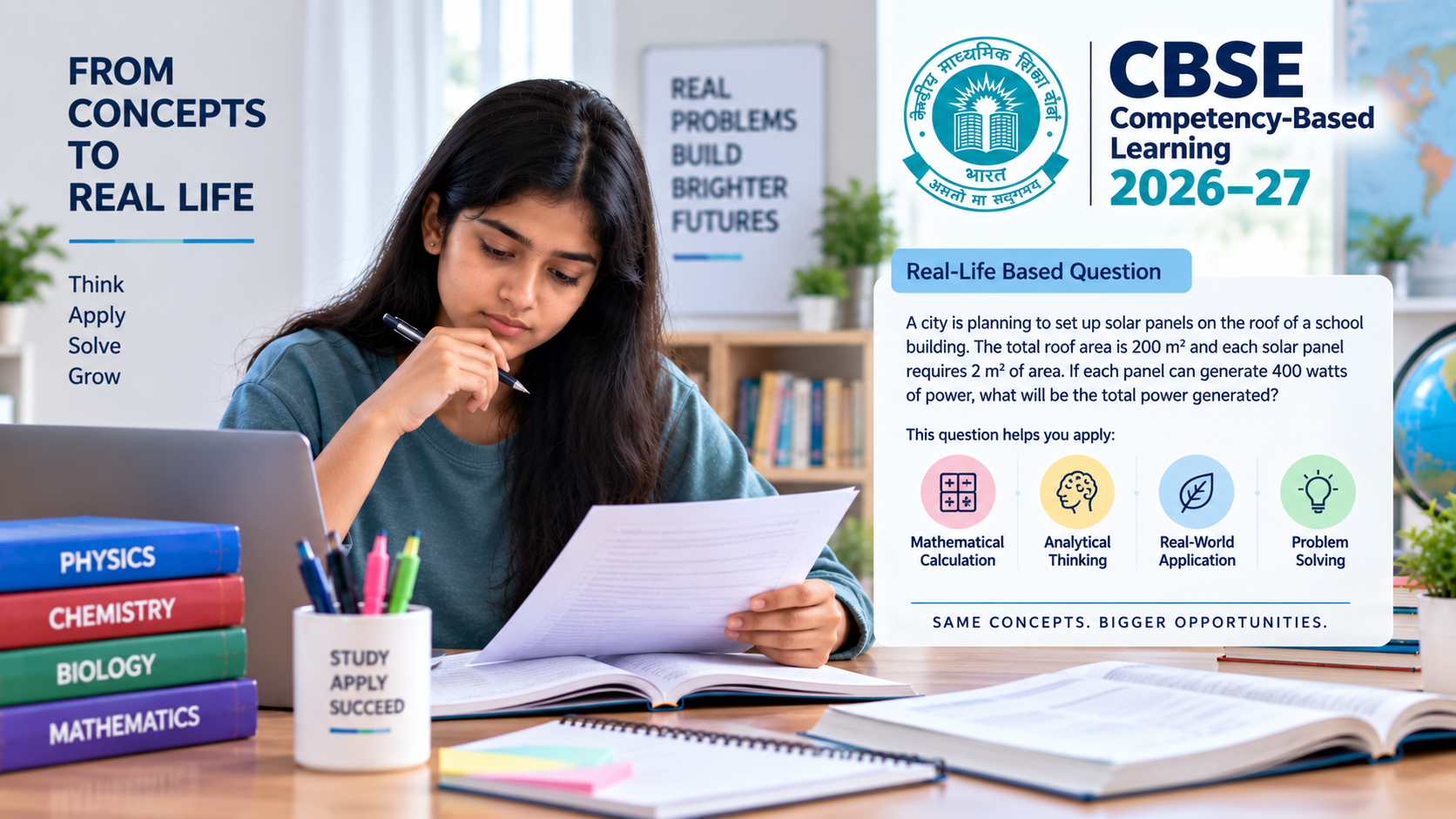
For example, instead of simply asking a student to state a scientific principle, an
application-based question may describe a real-world situation and ask the student to
identify which principle explains what is happening.
This is the basic idea behind CBSE competency based questions 2026-27.
How Are Competency-Based Questions Different?
Traditional questions often test whether a student remembers a definition, formula,
process or explanation. Competency-based questions can go one step further by testing
whether the student knows how to use that information.
| Question Style | What It Tests |
|---|---|
| Direct question | Recall and understanding |
| Application-based question | Ability to apply a concept |
| Case-based question | Understanding a situation and applying knowledge |
| Data-based question | Interpretation and analysis |
| Analytical question | Reasoning and drawing conclusions |
Why Is CBSE Moving Towards Application-Based Learning?
Education is increasingly focused on whether students can use knowledge beyond a
textbook exercise.
A student may remember a formula perfectly but still struggle when the same concept
appears in an unfamiliar problem. Application-based assessment helps identify whether
the student understands the underlying idea.
This approach also supports skills such as critical thinking, problem-solving,
interpretation and logical reasoning.
As a result, the CBSE exam pattern 2026-27 should be approached as
an opportunity to strengthen conceptual learning rather than simply as a change in
examination difficulty.
If you are also following the latest CBSE curriculum updates, read:
CBSE Curriculum Changes 2026–27: What Students and Parents Need to Know
.
What Types of Questions Should Students Practise?
Students should not prepare only one type of question. A balanced preparation strategy
should include direct questions as well as questions requiring application and reasoning.
1. Application-Based Questions
These questions require students to use a concept in a practical or unfamiliar situation.
The answer may depend on understanding the concept rather than recalling a prepared sentence.
2. Case-Based Questions
A case-based question may provide a short scenario, passage, experiment, situation or
context followed by one or more questions.
Students should first understand the information provided and then connect it with the
relevant concept.
3. Data-Based Questions
These questions may involve tables, graphs, charts, experimental observations or numerical
information. Students need to interpret the information before answering.
4. Analytical Questions
Analytical questions require students to compare information, identify relationships,
explain why something happens or draw a logical conclusion.
5. Assertion and Reasoning-Style Questions
Where included in a subject’s prescribed assessment pattern, students may need to evaluate
statements and determine the relationship between an assertion and its supporting reason.
CBSE Class 10 Exam Pattern 2026–27: What Should Students Focus On?
Class 10 students have an additional reason to plan carefully because CBSE introduced
the two-board-examination system for Class X from the 2026 examinations.
Students should therefore understand both the applicable examination rules and the
subject-wise assessment requirements.
At the same time, preparation should remain concept-focused. Students should practise
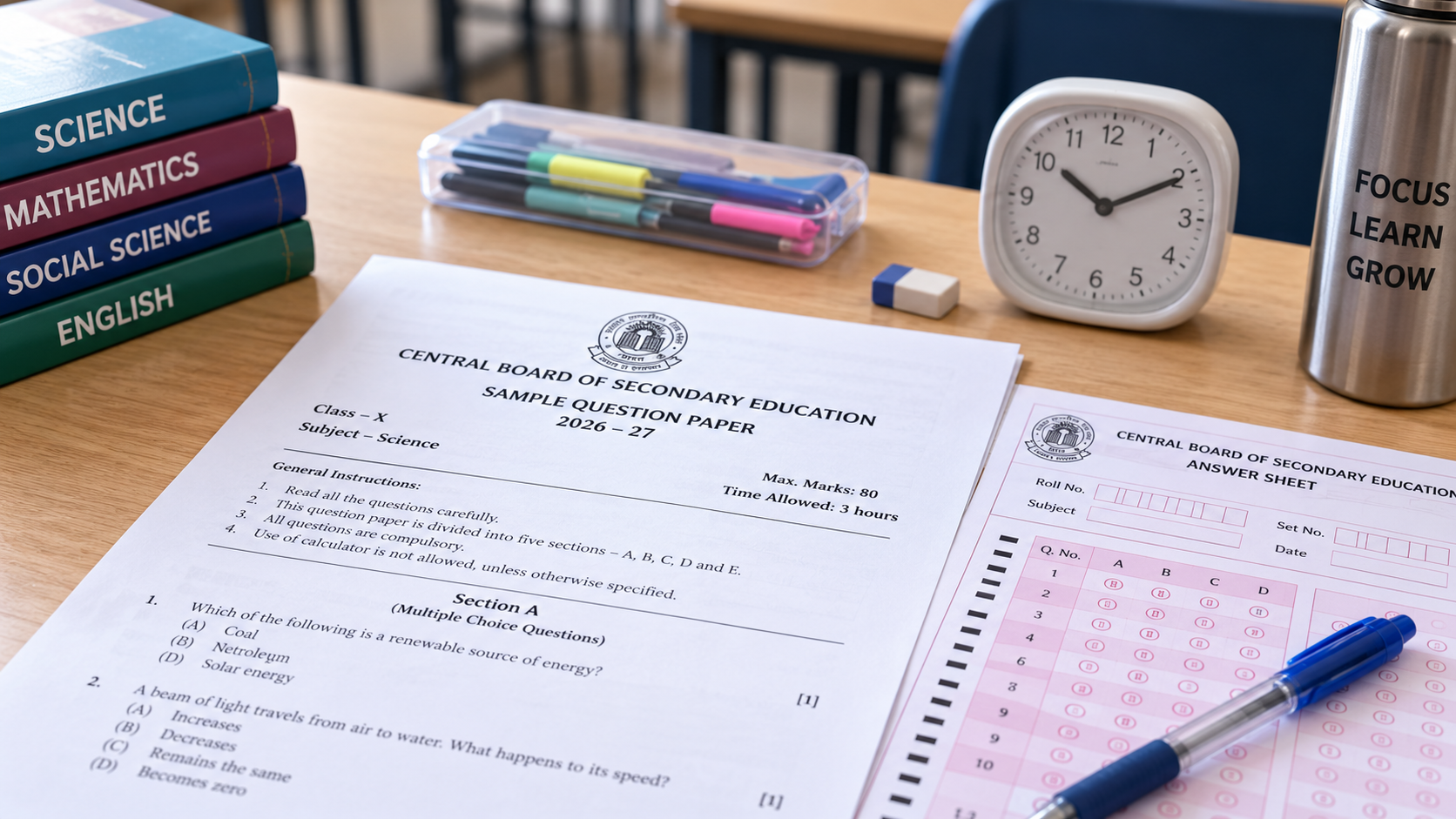
questions from the prescribed syllabus and use the latest CBSE Sample Question Papers
and marking schemes as important references.
The exact number and type of questions can differ by subject. Therefore, students should
avoid preparing from generic claims about one fixed percentage or question format for
every Class 10 subject.
You can also read our detailed guide:
CBSE Class 10 Two Board Exams 2026–27: What Parents Need to Know
.
CBSE Class 12 Exam Pattern 2026–27: What Students Should Know
Class 12 students should also pay close attention to conceptual and application-based
preparation.
However, students should not assume that the Class 10 examination structure automatically
applies to Class 12. CBSE publishes curriculum and assessment information separately for
different classes and subjects.
For Class 12, students should therefore follow the latest subject-specific syllabus,
Sample Question Paper and marking scheme issued by CBSE for their examination session.
The safest preparation strategy is to use official resources as the primary reference and
then supplement them with additional practice.
Rote Learning vs Conceptual Learning
Memorisation still has a role in education. Students need to remember formulas,
terminology, definitions, vocabulary, dates, processes and other essential information.
The problem begins when memorisation becomes the only study strategy.
For the modern CBSE exam pattern 2026-27, students should combine
memory with understanding and application.
A Better Study Model
- Learn: Understand the concept.
- Explain: Try explaining it in your own words.
- Apply: Solve a different type of problem.
- Analyse: Compare situations and identify patterns.
- Practise: Attempt questions without looking at the answer.
- Review: Identify mistakes and correct them.

How Can Parents Help Students Prepare?
Parents do not need to become subject experts to support their child’s preparation.
A calm and structured environment can make a significant difference to daily study habits.
Encourage Understanding Instead of Memorisation
Ask your child to explain a concept in their own words. If they can explain it clearly,
they are more likely to understand it.
Encourage Practice With Different Questions
Instead of repeatedly solving the same type of exercise, encourage students to attempt
questions that present the concept in different ways.
Review Mistakes
Mistakes are useful when students understand why they happened. Maintain a simple
mistake log where students record difficult questions and the reason for each error.
Avoid Unnecessary Pressure
The purpose of preparation is to improve understanding and confidence. Constant pressure
to score can sometimes make students focus more on marks than learning.
5-Step CBSE Board Exam Preparation Strategy for 2026–27
Step 1: Start With the Official Syllabus
Before creating a study plan, students should understand exactly what is included in
their prescribed syllabus.
Step 2: Understand Every Chapter
Do not move immediately to question banks. First make sure the underlying concepts are clear.
Step 3: Practise Application Questions
After learning a chapter, solve questions that require the concept to be used in a new
situation.
Step 4: Attempt Official Sample Papers
CBSE Sample Question Papers are especially useful because they help students understand
the question-paper design applicable to their subjects.
Step 5: Analyse Your Performance
After completing a practice paper, do not only check the marks. Identify whether mistakes
came from conceptual gaps, careless errors, poor time management or difficulty
understanding the question.

Common Mistakes Students Make While Preparing for CBSE Exams
Mistake 1: Studying Only From Memorised Answers
Students may remember a prepared answer but struggle when the question is presented
differently.
Mistake 2: Ignoring the Question’s Context
In case-based or application-based questions, every detail in the question may matter.
Students should read the complete question before jumping to an answer.
Mistake 3: Practising Only Easy Questions
Easy questions are useful for building confidence, but students should gradually include
unfamiliar and application-oriented questions.
Mistake 4: Not Reviewing Errors
Completing hundreds of questions without analysing mistakes does not automatically lead
to better performance.
Mistake 5: Ignoring Official CBSE Resources
Students should not depend entirely on coaching notes, social media posts or unofficial
predictions. The latest CBSE documents should remain the primary reference.
How EduEnrich Global Can Support CBSE Students
Preparing for changing assessment patterns requires more than simply increasing study
hours. Students need to understand concepts, practise effectively and identify where
they need additional support.
EduEnrich Global provides personalised academic support across multiple curricula,
subjects and grade levels.
Our approach focuses on helping students strengthen concepts, improve problem-solving
ability and develop a consistent academic routine.
Help Your Child Prepare Smarter for CBSE Exams
Give your child structured academic support designed around their learning needs,
subjects and curriculum.
Frequently Asked Questions About the CBSE Exam Pattern 2026–27
1. What is the CBSE exam pattern 2026-27?
The CBSE exam pattern 2026-27 refers to the examination and assessment structure
applicable during the 2026–27 academic session. The exact pattern varies by class
and subject, so students should follow the latest official CBSE curriculum and
Sample Question Papers.
2. What are competency-based questions in CBSE exams?
Competency-based questions test whether students can apply what they have learned
to a situation, problem, data set, case or unfamiliar context instead of simply
recalling information.
3. Are CBSE exams becoming completely competency-based?
Students should not assume that every question will follow one single competency-based
format. CBSE uses different question types depending on the class and subject.
The official Sample Question Paper for the relevant subject provides the best indication
of the prescribed paper design.
4. How should Class 10 students prepare for the CBSE exams in 2026–27?
Class 10 students should focus on conceptual understanding, application-based practice,
official sample papers, previous practice questions, time management and careful review
of mistakes.
5. Is the CBSE Class 12 exam pattern the same as Class 10?
No. Students should not assume that the Class 10 and Class 12 examination structures
are identical. CBSE provides class- and subject-specific curriculum and assessment
information.
6. Are competency-based questions harder?
They can feel unfamiliar when students are used to memorising answers. However,
students who understand concepts and practise applying them can become more comfortable
with these questions.
Related CBSE Guides for Parents and Students
CBSE Class 10 Two Board Exams 2026–27: What Parents Need to Know
CBSE Curriculum Changes 2026–27: What Students and Parents Need to Know
CBSE Three-Language Policy 2026–27: What Parents and Students Need to Know
CBSE Class 10 Preparation Tips for Students
Official CBSE Resources
For the most accurate and current information, students and parents should refer
to official CBSE documents rather than relying on general predictions about exam patterns.
Conclusion: Prepare for Understanding, Not Just for the Exam
The CBSE exam pattern 2026-27 is best approached with a shift in
preparation strategy rather than fear of new question formats.
Students should continue learning the prescribed syllabus thoroughly, but they should
also practise applying concepts, interpreting information, solving unfamiliar problems
and explaining their reasoning.
Parents can support this process by encouraging consistent study habits instead of
last-minute memorisation.
Most importantly, students should use the latest official CBSE curriculum, Sample
Question Papers and marking schemes for their specific subjects because the exact
assessment structure can vary.
The goal is not simply to prepare students for a question paper. It is to help them
understand what they learn and confidently use that knowledge when the question
looks different.