
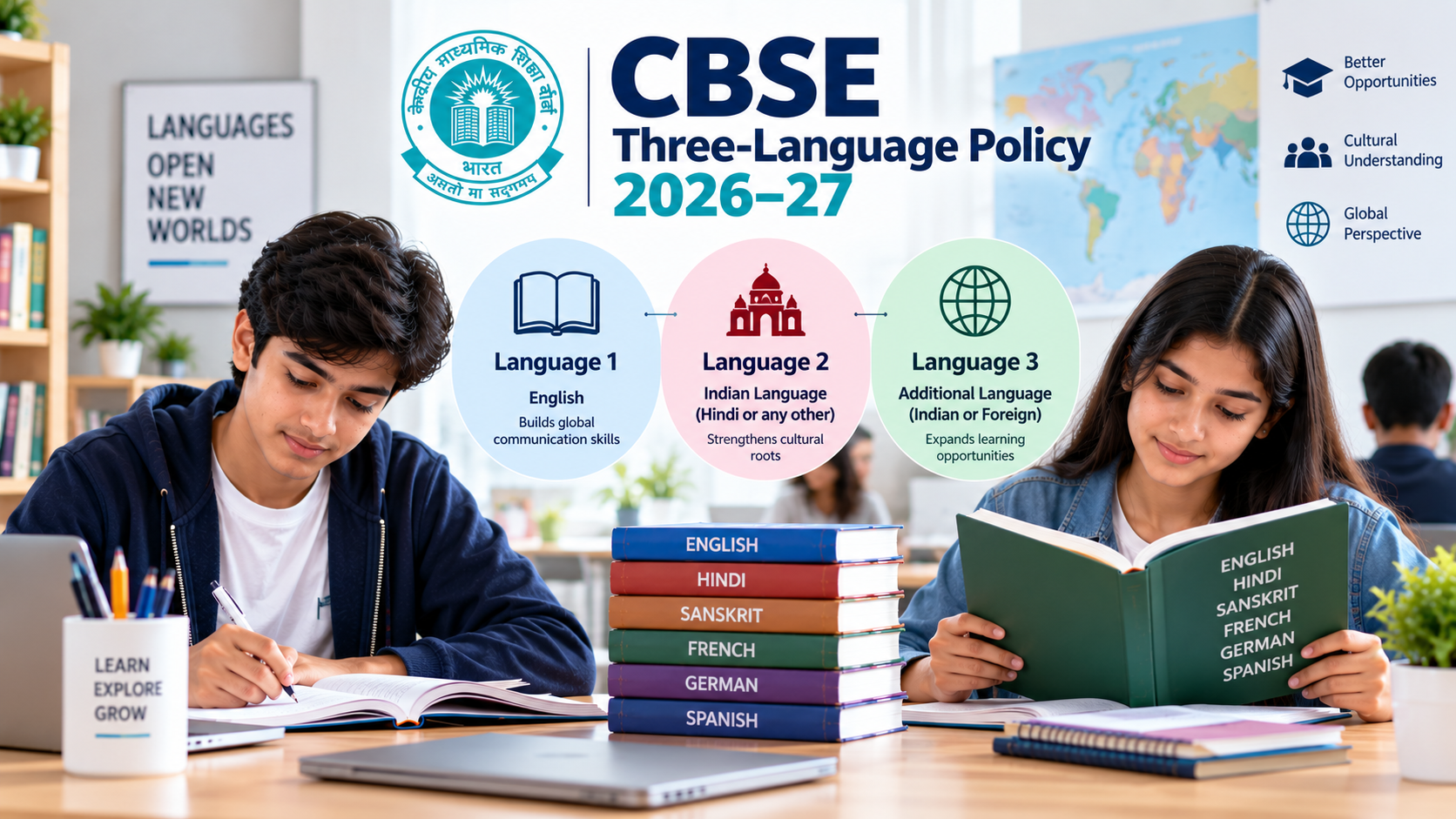
CBSE Three-Language Policy 2026–27: What Parents and Students Need to Know
Language learning is becoming an increasingly important part of the CBSE secondary curriculum.
With the CBSE three language policy 2026 coming into effect for the new academic
session, many parents are wondering what has changed, which students are affected, and how
language choices may influence their child’s academic planning.
The CBSE Academic Curriculum for 2026–27 provides separate curriculum structures for Class IX,
Class X and Classes XI–XII. The updated curriculum also includes a wide range of Indian and
foreign language options.
In this guide, we explain the CBSE three language policy 2026 in simple terms,
with particular attention to Classes 9 and 10.
CBSE Three-Language Policy 2026: Quick Summary
- CBSE has updated the language structure for the 2026–27 academic session.
- For Class IX, the three-language framework is an important part of the updated scheme.
- Students may have different language combinations depending on their school and the languages offered.
- Parents should check their school’s approved subject combination before finalising language choices.
- The detailed curriculum and language syllabi are available through the official CBSE Academic website.
What Is the CBSE Three-Language Policy 2026?
The CBSE three language policy 2026 refers to the updated language-learning
framework introduced as part of CBSE’s 2026–27 curriculum structure.
Under the updated framework, language learning receives greater importance in the secondary
stage. Students in the applicable classes study three languages according to the scheme,
combinations and language availability prescribed by CBSE and implemented by their school.
The purpose is not simply to make students memorise additional grammar rules. Instead,
language education is intended to support communication, reading, writing, cultural awareness
and broader learning.
CBSE’s official 2026–27 curriculum lists numerous language options, including English, Hindi,
Sanskrit, French, German, Spanish, Tamil, Telugu, Kannada, Malayalam, Marathi, Bengali and
several other Indian and foreign languages.
Why Has CBSE Introduced This Language Update?
India’s education system has been moving towards a more flexible and multilingual approach.
The emphasis on language learning is also connected with the broader educational direction
under the National Education Policy.
A stronger language-learning framework can help students develop communication skills while
also giving them opportunities to understand different Indian languages and cultures.
However, parents should not assume that every student will study the same three languages.
The actual combination depends on the applicable CBSE scheme and the languages available
through the student’s school.
If you are also planning for the wider CBSE academic changes, read our guide:
CBSE Curriculum Changes 2026–27: What Students and Parents Need to Know
.
What Changes for Class 9 Students?
Class 9 is particularly important when discussing the CBSE three language policy
2026, because the updated 2026–27 curriculum places the three-language structure
directly within the Class IX scheme.
From the 2026–27 academic session, students entering Class IX need to understand their
school’s language combination before selecting or confirming subjects.
This means parents should not rely only on information shared through social media,
WhatsApp groups or older CBSE documents. The latest school circular and the official
CBSE curriculum should be checked together.
What Parents Should Check
- Which three languages are offered by the school.
- Which language is treated as R1, R2 or R3 under the applicable scheme.
- Whether the chosen combination is available in the school.
- How each language will be assessed.
- Whether the student’s existing language background affects the available options.
What About Class 10 Students?
One important point for parents is that the Class IX and Class X curriculum pages should not
be treated as identical.
CBSE publishes a separate Secondary Curriculum for Class IX and Class X. The Class X
curriculum for 2026–27 continues to provide its own language group and subject structure.
Therefore, parents of Class 10 students should check the curriculum applicable to their
child’s batch rather than assuming that every new Class IX language provision automatically
applies in exactly the same way to Class X.
This distinction is especially important during a curriculum transition. Schools may also
provide specific instructions about subject combinations and language continuation.
Important for Class 10 Parents
Do not change a student’s language combination based only on online articles or social
media posts. Confirm the applicable subject combination with the school and refer to the
current CBSE curriculum before making an academic decision.
Does the CBSE Three-Language Policy Affect Every Student in the Same Way?
No. This is one of the most important points parents should understand.
The CBSE three language policy 2026 provides a framework, but the actual
experience can vary depending on the school, available languages, the student’s existing
language combination and the applicable class-level curriculum.
For example, a school may offer Hindi, English and a regional language, while another school
may offer a different combination depending on its approved curriculum and resources.
CBSE’s 2026–27 curriculum itself demonstrates the breadth of language choices available.
The official Class IX curriculum page includes Indian languages as well as languages such as
French, German, Spanish and Japanese. :contentReference[oaicite:1]{index=1}
What Should Parents Know About Language Choices?
Choosing a language should not be treated as a last-minute administrative decision.
Students generally perform better when the language fits their background, interests and
learning ability.
1. Consider the Student’s Existing Language Background
If a child already has a strong foundation in a particular language, continuing that
language may provide academic continuity.
2. Check the School’s Language Availability
Not every school offers every language listed by CBSE. Parents should first obtain the
school’s actual subject and language options.
3. Consider Future Academic Plans
Language choices may also be relevant when students later move into Classes 11 and 12,
higher education or international academic pathways.
4. Do Not Choose Only Because a Language Is Considered “Easy”
A language that appears easy initially may still require consistent reading, writing,
vocabulary development and practice.

How Will Students Benefit From Learning Three Languages?
Learning multiple languages can contribute to a student’s broader communication and
literacy development.
More importantly, language learning can encourage students to understand different ways of
expressing ideas, communicate with a wider range of people and develop cultural awareness.
For students who already speak more than one language at home, school-based language
learning can also create opportunities to strengthen reading and writing skills.
At the same time, the additional academic workload should not be ignored. Students need a
structured approach so that language learning does not become a source of unnecessary stress.
How Can Students Prepare for the CBSE Three-Language Policy 2026?
Students do not need to wait until examinations are approaching. Regular practice is far
more effective for language subjects.
Build Vocabulary Every Week
Encourage students to maintain a small vocabulary notebook. New words can be grouped by
topic and reviewed regularly.
Read Beyond the Textbook
Reading short stories, articles, newspapers or age-appropriate books can improve vocabulary,
comprehension and sentence construction.
Practise Writing Regularly
Students should practise different writing formats instead of repeatedly writing the same
type of answer.
Develop Speaking and Listening Skills
Language learning is not limited to written examinations. Students should also have
opportunities to listen, speak and communicate naturally.
Use the Official Curriculum
The latest CBSE curriculum should be the starting point for understanding the syllabus,
assessment structure and prescribed learning expectations.
Common Misunderstandings About the CBSE Three-Language Policy
Misunderstanding 1: Every Student Must Study the Same Three Languages
This is not a safe assumption. The available language combination depends on the applicable
CBSE framework and the school’s approved offerings.
Misunderstanding 2: All Three Languages Have Exactly the Same Assessment Pattern
Assessment can differ according to the language and its prescribed framework. Parents should
review the applicable syllabus and assessment instructions rather than assuming identical
requirements.
Misunderstanding 3: The New Class IX Rules Automatically Mean the Same Rules for Class X
Class IX and Class X have separately published curriculum structures. Parents should always
check the rules applicable to the student’s specific class and academic session.
Misunderstanding 4: Language Learning Is Only About Memorising Grammar
Modern language education involves reading, writing, listening, speaking, comprehension and
communication. Students should therefore prepare through practical language use as well as
textbook study.
What Parents Should Do Now
If your child is entering Class IX during the 2026–27 academic session, this is a good time
to understand the school’s language structure rather than waiting for the first assessment.
- Ask the school for the official 2026–27 subject and language combination.
- Check which languages are available for R1, R2 and R3 where applicable.
- Review the prescribed CBSE syllabus for each language.
- Understand how each language will be assessed.
- Discuss the student’s strengths and preferences before finalising choices.
- Create a weekly language-learning routine from the beginning of the academic year.
CBSE Language Planning: What Parents Should Focus On
| Area | What Parents Should Check |
|---|---|
| Language combination | Which languages the school offers under the applicable CBSE framework |
| Class | Confirm whether the student is in Class IX or Class X |
| Syllabus | Use the current 2026–27 CBSE curriculum |
| Assessment | Check the assessment requirements for each language |
| Preparation | Build regular reading, writing, listening and speaking practice |
Related CBSE Guides for Parents
-
CBSE Class 10 Two Board Exams 2026–27: What Parents Need to Know
-
CBSE Curriculum Changes 2026–27: What Students and Parents Need to Know
-
CBSE Class 10 Preparation Tips for Students
-
CBSE Exam Preparation Guide for Parents and Students
Need Help Planning Your Child’s CBSE Learning Journey?
Curriculum changes can sometimes leave parents with more questions than answers.
From understanding subjects and languages to strengthening concepts and preparing for
assessments, students benefit from a structured academic approach.
EduEnrich Global supports students with personalised academic guidance
across multiple curricula and subjects.
Frequently Asked Questions About the CBSE Three-Language Policy 2026
1. What is the CBSE three-language policy 2026?
The CBSE three-language policy 2026 is part of the updated language structure for the
2026–27 academic session. It places greater emphasis on multilingual learning, with
three-language study forming part of the applicable Class IX framework.
2. Is the three-language policy applicable to Class 9?
Yes. The 2026–27 CBSE curriculum includes a three-language structure for Class IX.
Parents should check their school’s specific language offerings and applicable subject
combination.
3. Does the CBSE three-language policy 2026 apply exactly the same way to Class 10?
Parents should not assume that Class IX and Class X have identical arrangements.
CBSE publishes separate curriculum structures for Class IX and Class X, so the applicable
rules should be checked for the student’s specific class and academic session.
4. Can students choose any three languages?
Not necessarily. Students must follow the applicable CBSE scheme and the language
options available through their school. The school should confirm which combinations
are permitted.
5. Which languages are available under the CBSE curriculum?
CBSE’s 2026–27 curriculum includes a broad selection of Indian and foreign languages,
including English, Hindi, Sanskrit, French, German, Spanish, Tamil, Telugu, Kannada,
Malayalam and several others. Availability varies by school.
6. How should students prepare for three languages?
Students should build consistent reading, writing, vocabulary, listening and speaking
habits. Studying a little every week is generally more manageable than leaving language
preparation until examinations are close.
Official CBSE Resources
Parents should always use the latest CBSE documents when making decisions about
curriculum, subjects and language requirements.
Conclusion: What Parents Should Remember
The CBSE three language policy 2026 is an important development for
students entering the updated secondary curriculum, particularly Class IX students in the
2026–27 academic session.
The most important thing for parents is not to panic about the additional language
requirement. Instead, understand the school’s language options, check the latest CBSE
curriculum, and help your child establish a steady learning routine.
Since CBSE provides separate curriculum structures for Class IX, Class X and Classes XI–XII,
always check the rules applicable to your child’s specific class rather than relying on
general information.
With the right planning, language learning can become more than another subject on the
timetable. It can strengthen communication, comprehension and broader academic skills.
Planning early is the easiest way to turn a curriculum change into a manageable
academic routine.