
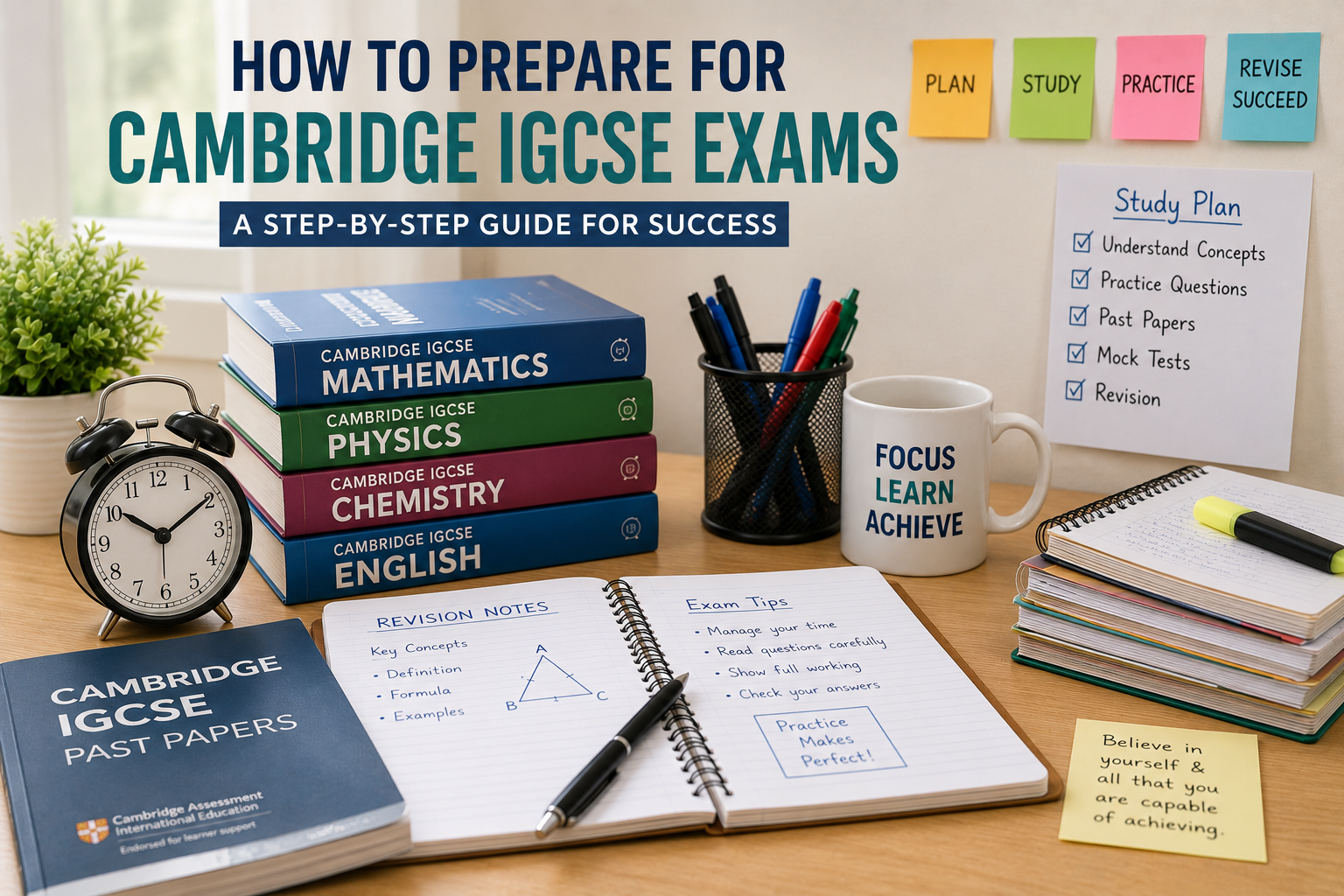
Cambridge IGCSE Exam Preparation becomes much easier when
students follow a structured study plan instead of trying to revise the
entire syllabus at the last minute. Effective preparation involves
understanding the syllabus, building strong concepts, practising questions,
revising regularly, using past papers, analysing mistakes, and developing
effective examination strategies.
Cambridge IGCSE students study a wide range of subjects, and each subject
can require a different preparation approach. Therefore, students should
combine subject knowledge with regular practice and a realistic revision
schedule.
Whether you are a student preparing independently or a parent supporting
your child’s studies, this guide explains how to approach
Cambridge IGCSE Exam Preparation step by step.
What Is Cambridge IGCSE Exam Preparation?
Cambridge IGCSE Exam Preparation is the process of
preparing systematically for Cambridge IGCSE assessments by developing
subject knowledge, practising examination-style questions, revising key
concepts, and improving examination techniques.
Good preparation is not simply about studying for longer hours.
Instead, students should focus on studying effectively. For example,
understanding a difficult concept, solving questions, reviewing mistakes,
and revising the topic later can be more useful than repeatedly reading
the same textbook chapter.
Consequently, students should create a preparation strategy that combines
learning, practice, revision, assessment, and rest.
Why Should Students Start Cambridge IGCSE Exam Preparation Early?
Starting early gives students enough time to understand difficult topics
and identify areas that need additional attention. Moreover, early
preparation reduces the pressure that often comes from attempting to
complete the syllabus shortly before examinations.
A longer preparation period also allows students to revisit challenging
concepts several times. As a result, they can gradually improve their
understanding instead of relying only on last-minute memorization.
Most importantly, early Cambridge IGCSE Exam Preparation
allows students to leave enough time for past-paper practice, mock tests,
revision, and final review.
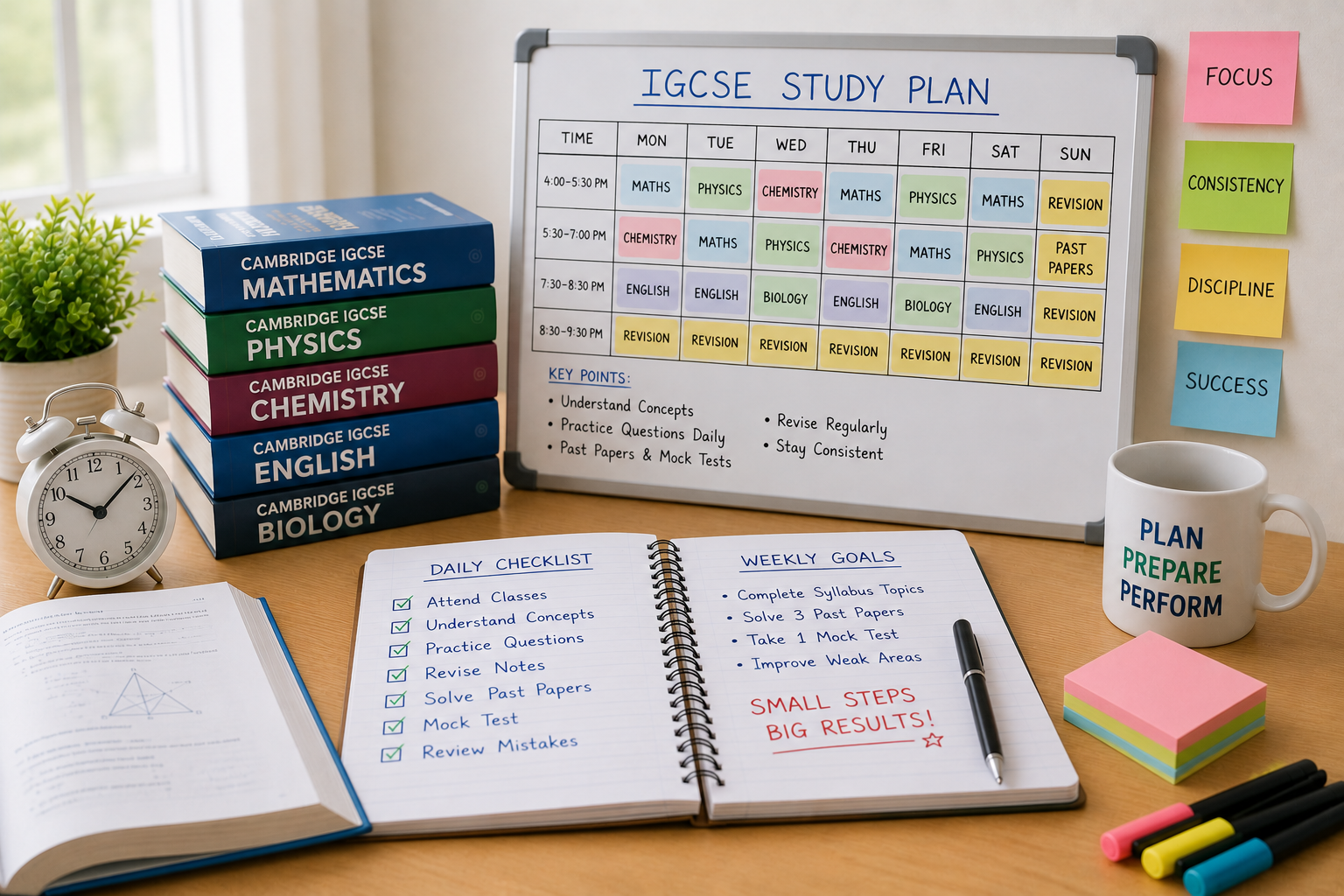
How to Create a Cambridge IGCSE Study Plan
A realistic study plan provides direction and helps students divide a
large syllabus into manageable sections. However, the plan should remain
flexible enough to accommodate schoolwork, revision needs, and unexpected
challenges.
Step 1: Understand Your Syllabus
Begin by understanding the syllabus for each subject. Make a list of the
major topics and identify which areas are already comfortable and which
require additional study.
Students should use reliable curriculum information and study materials
rather than depending entirely on random online notes.
Step 2: Set Realistic Study Goals
Instead of setting a goal such as “study Mathematics all day,” create
specific goals such as completing a particular topic, solving a set of
questions, or revising a specific concept.
Step 3: Divide Topics Into Smaller Sections
Breaking the syllabus into smaller sections makes revision more manageable.
Furthermore, students can track what they have completed and identify what
still requires attention.
Step 4: Schedule Regular Revision
Revision should not happen only before the examination. Instead, schedule
short revision sessions throughout the preparation period so that important
concepts are revisited regularly.
Step 5: Include Practice and Mock Tests
Reserve dedicated time for question practice and mock examinations.
Consequently, students can improve both their subject knowledge and
examination technique.
10 Effective Cambridge IGCSE Exam Preparation Tips
1. Start Preparing Early
Begin preparation well before the examination period. Early preparation
gives you enough time to understand concepts, practise questions, revise
difficult topics, and complete mock tests.
2. Understand Concepts Before Memorizing
Conceptual understanding should come before memorization whenever possible.
This is particularly important for subjects such as Mathematics, Physics,
Chemistry, and Biology, where students often need to apply concepts to
unfamiliar questions.
3. Create Short Revision Notes
Prepare concise notes containing important formulas, definitions,
processes, diagrams, key terms, and difficult concepts. These notes can
make final revision more efficient.
4. Practise Questions Regularly
Regular question practice helps students understand how knowledge is
applied. Therefore, do not wait until the final weeks before solving
examination-style questions.
5. Use Cambridge IGCSE Past Papers
Past papers can help students become familiar with examination formats,
question styles, command words, and time requirements. Use them as a
learning tool rather than simply as a test.
6. Analyse Your Mistakes
After completing practice questions, review incorrect answers carefully.
Ask why the answer was incorrect and what could be done differently next
time.
7. Improve Time Management
Students should practise answering questions within appropriate time
limits. As examination day approaches, timed practice can help develop
greater confidence and improve pacing.
8. Take Mock Tests
Mock tests provide an opportunity to practise under examination-like
conditions. Moreover, they can reveal topics that require additional
revision before the actual examination.
9. Revise Difficult Topics More Often
Not every topic requires the same amount of revision. Spend additional
time on subjects or topics where your performance is weaker.
10. Protect Your Sleep and Well-Being
Effective Cambridge IGCSE Exam Preparation should also
include sufficient sleep, breaks, healthy routines, and time away from
study. Studying continuously without adequate rest can make concentration
more difficult.
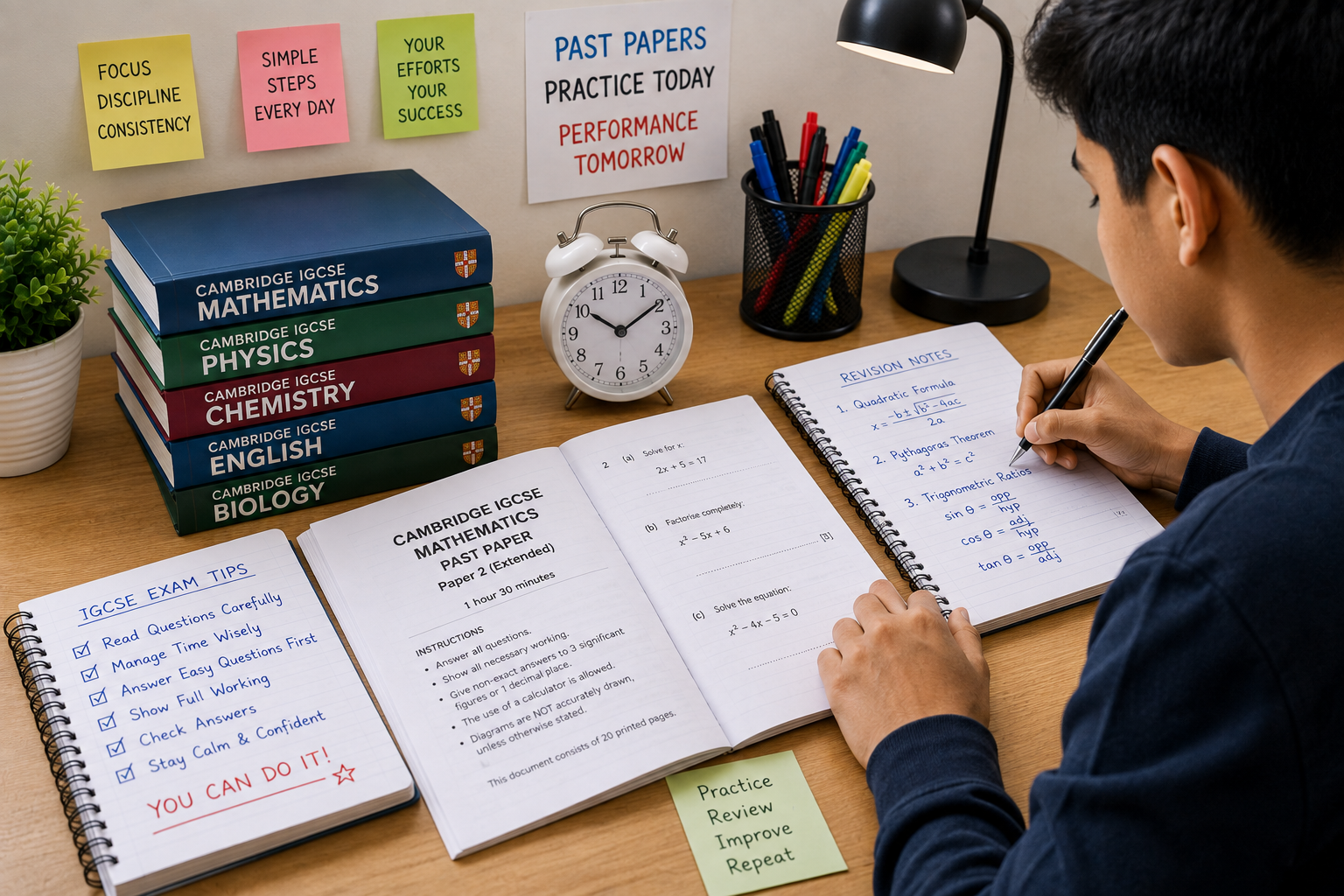
How to Use IGCSE Past Papers Effectively
Past papers can be an important part of IGCSE Exam
Preparation. However, students should use them strategically.
Simply completing paper after paper without reviewing mistakes may limit
the benefit.
Start With Topic-Based Practice
If you are still learning the syllabus, begin by practising questions
related to individual topics. This approach helps identify gaps while
concepts are still being developed.
Move Towards Full Papers
Once most topics are understood, begin completing full papers under timed
conditions. This gradually prepares students for the demands of the actual
examination.
Review Every Mistake
Keep a mistake log containing questions that were answered incorrectly or
incompletely. Then, revisit the underlying concept and attempt a similar
question again.
Practise Time Management
Timed practice can help students understand how much time they should spend
on different questions. Consequently, students can develop a more
comfortable examination pace.
How to Prepare for Different Cambridge IGCSE Subjects
Every subject requires a slightly different study strategy. Therefore,
students should adapt their Cambridge IGCSE Exam
Preparation approach according to the subject.
Cambridge IGCSE Mathematics
Mathematics preparation should focus on understanding formulas, practising
different question types, solving problems regularly, and reviewing
mistakes. Students should gradually move from basic questions to more
challenging examination-style problems.
Cambridge IGCSE Physics
Physics preparation should combine conceptual understanding, formulas,
diagrams, calculations, and application-based questions. Students should
practise explaining physical principles rather than memorizing formulas
without understanding them.
Cambridge IGCSE Chemistry
Chemistry preparation can involve understanding chemical concepts,
equations, reactions, definitions, practical concepts, and calculations.
Regular revision is particularly useful for connecting related topics.
Cambridge IGCSE Biology
Biology students should focus on understanding processes, terminology,
diagrams, functions, and relationships between concepts. Active recall and
structured revision can make large amounts of information easier to manage.
Cambridge IGCSE English
English preparation can involve reading comprehension, vocabulary,
writing structure, grammar, analysis, and communication skills. Regular
reading and writing practice can help students improve clarity and
confidence.
Cambridge IGCSE Economics and Business Studies
Students should understand key concepts and practise applying them to
real-world situations and examination questions. Definitions alone may
not be enough; students should also understand how and when to apply
concepts.
Common Cambridge IGCSE Exam Preparation Mistakes to Avoid
Even students who study consistently can make preparation mistakes.
Recognizing these problems early can make the study process more effective.
- Starting the entire syllabus only a few weeks before the examination
- Memorizing answers without understanding concepts
- Avoiding difficult topics
- Studying without a realistic schedule
- Completing past papers without reviewing mistakes
- Ignoring time management
- Studying one subject exclusively while neglecting others
- Not taking sufficient breaks
- Relying on unverified study materials
- Leaving revision until the final days
Instead, students should use a balanced strategy that combines concept
learning, practice, revision, assessment, and rest.
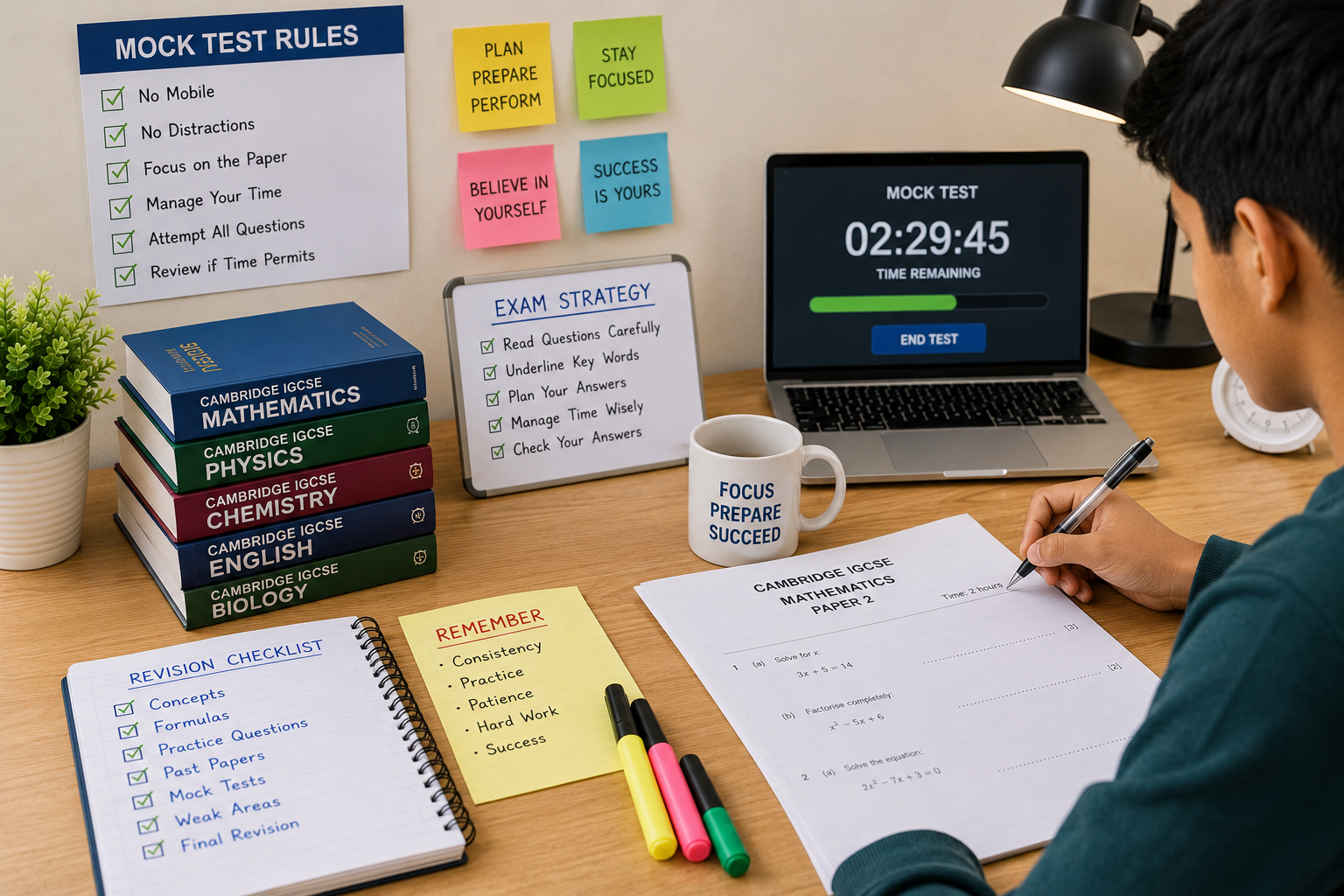
How Online IGCSE Tuition Can Support Exam Preparation
Students who need additional academic support can consider
IGCSE Online Tuition as part of their preparation
strategy. A suitable tutor can help explain difficult concepts, provide
practice questions, review mistakes, and structure revision according to
the student’s needs.
With personalized Cambridge IGCSE Online Tuition, students
can focus more attention on subjects or topics where they need additional
support. Furthermore, one-to-one sessions can provide an opportunity to
ask questions and receive immediate feedback.
However, tuition should complement independent study rather than replace
it. Students should continue practising, revising, and applying concepts
independently between sessions.
If you are looking for guidance on choosing a suitable tutor, read our
related guide:
How to Choose the Best IGCSE Online Tutor for Your Child
.
When Should Students Start Preparing for Cambridge IGCSE Exams?
There is no single preparation timeline that works for every student.
However, students generally benefit from starting structured preparation
well before the examination period.
Students who begin early can spend the initial stage building concepts,
followed by regular practice, revision, past papers, and mock examinations.
Consequently, the final weeks can be used for targeted revision rather
than attempting to learn large amounts of new material.
Early Preparation
Focus on understanding concepts and keeping up with school lessons.
Mid-Stage Preparation
Increase question practice, revision, and topic-based assessment.
Final Preparation
Focus on past papers, timed practice, mistake review, difficult topics,
and final revision.
A Simple Weekly Cambridge IGCSE Study Routine
A weekly routine can make Cambridge IGCSE Exam
Preparation more manageable. The exact schedule should be adapted
to the student’s school timetable and academic requirements.
| Study Activity | Recommended Focus |
|---|---|
| Concept Learning | Understand new or difficult topics |
| Question Practice | Apply concepts through examination-style questions |
| Revision | Review previously learned topics |
| Past Papers | Practise Cambridge-style examination questions |
| Mistake Review | Identify and correct recurring errors |
| Mock Test | Practise under timed examination conditions |
| Rest | Maintain healthy sleep and recovery |
How Parents Can Support Cambridge IGCSE Exam Preparation
Parents can support students by creating a positive study environment and
helping them maintain a realistic routine. However, excessive pressure can
sometimes make preparation more stressful.
Encourage Consistency
Encourage regular study habits instead of focusing only on the number of
hours studied.
Monitor Progress
Ask about completed topics, practice results, and areas where the student
needs help.
Encourage Questions
Students should feel comfortable discussing difficult subjects and asking
for additional support when needed.
Support Healthy Routines
Adequate sleep, breaks, physical activity, and balanced routines can help
students maintain concentration during longer preparation periods.
Frequently Asked Questions About Cambridge IGCSE Exam Preparation
How should I start Cambridge IGCSE Exam Preparation?
Start by understanding your syllabus, identifying difficult topics,
creating a realistic study plan, and scheduling regular concept learning,
practice, and revision.
How many hours should I study for IGCSE exams?
There is no fixed number of hours suitable for every student. Study time
should depend on the student’s grade, subjects, existing understanding,
school workload, and examination timeline. Consistent and focused study is
generally more useful than simply studying for long hours.
Are Cambridge IGCSE past papers important?
Past papers can help students become familiar with examination questions,
formats, timing, and expectations. They are particularly useful when
combined with careful review of mistakes.
When should I start preparing for Cambridge IGCSE exams?
Students benefit from beginning preparation early enough to understand the
syllabus, practise questions, revise difficult topics, and complete mock
examinations without relying on last-minute study.
How can I improve my IGCSE exam performance?
Focus on conceptual understanding, regular practice, past papers, mistake
analysis, revision, time management, and mock tests. If additional help is
needed, consider working with a suitable IGCSE tutor.
Is online IGCSE tuition useful for exam preparation?
Online tuition can provide personalized academic support, concept
clarification, question practice, revision guidance, and examination
preparation. Its effectiveness depends on the student’s requirements and
the quality and suitability of the tutor.
Prepare for Cambridge IGCSE Exams With EduEnrich Global
Successful preparation is built through consistent learning, purposeful
practice, effective revision, and regular feedback. If your child needs
additional academic guidance, EduEnrich Global provides personalized
online learning support based on the student’s curriculum, subjects, grade,
and learning requirements.
Our Cambridge IGCSE Online Tuition approach can help
students strengthen concepts, practise questions, address learning gaps,
and prepare more systematically for examinations.
Discuss Your Child’s Learning Requirements
You can also explore
EduEnrich Global’s curriculum programs
to learn more about available academic support.
Explore More EduEnrich Global Resources
Official Cambridge IGCSE Resources
Students and parents should use reliable curriculum information when
planning their studies. For official information about Cambridge IGCSE
qualifications, subjects, curriculum, and assessment, visit:
Personalized Cambridge IGCSE Learning Support
Every student has different learning needs. Personalized academic support
can help students focus on concepts and subjects that require additional
attention.
Consistent Practice Leads to Better Exam Readiness
Regular practice, revision, feedback, and effective time management can
help students approach their Cambridge IGCSE examinations with greater
preparation and confidence.