
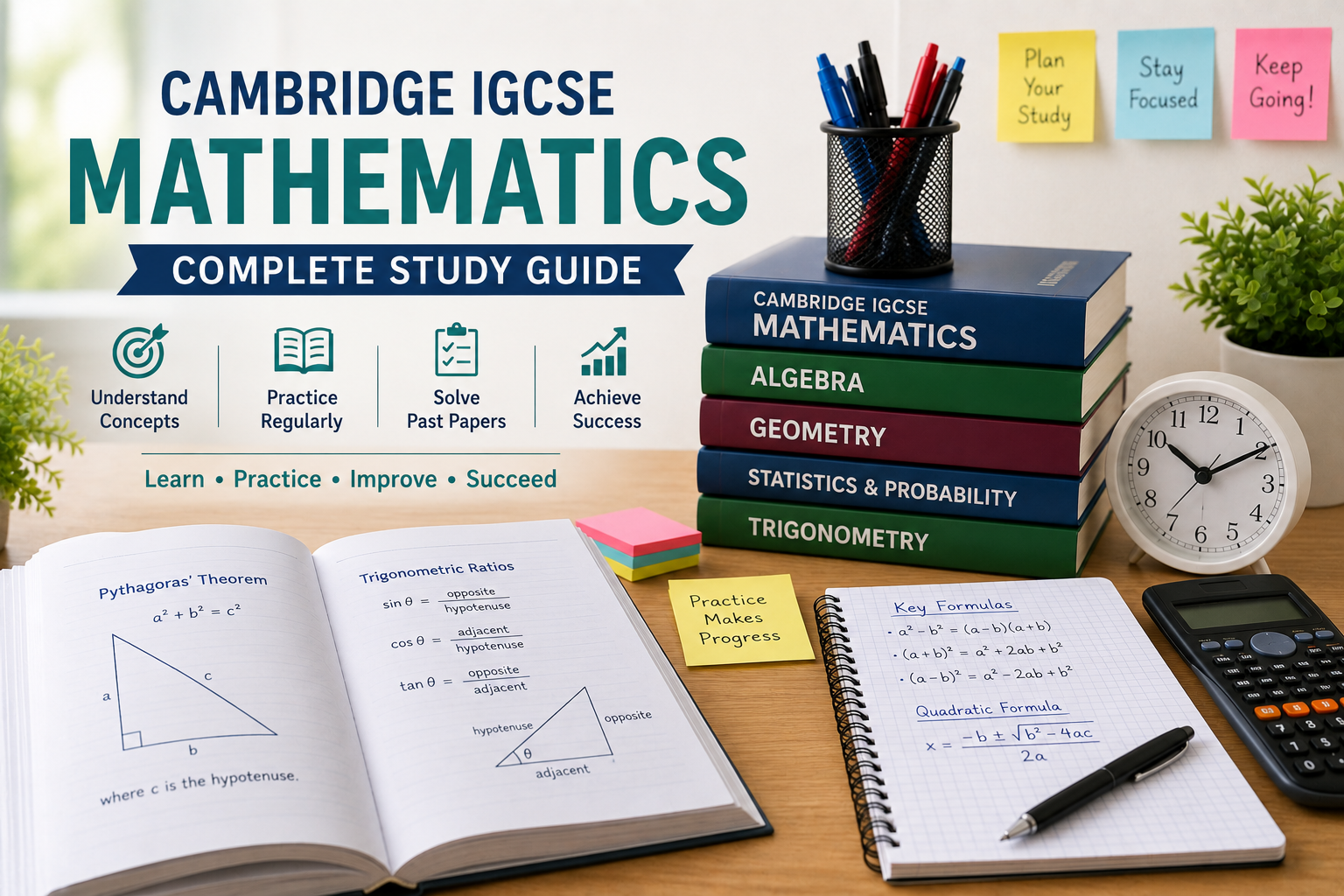
Cambridge IGCSE Mathematics helps students develop
mathematical knowledge, problem-solving skills, logical thinking, and the
ability to apply mathematical methods to different situations. However,
preparing for IGCSE Mathematics requires more than memorizing formulas.
Students need to understand concepts, practise different question types,
identify mistakes, and develop confidence in applying mathematical
techniques.
Whether a student is beginning the course, preparing for school
assessments, or getting ready for final examinations, a structured approach
to Cambridge IGCSE Mathematics can make preparation more
manageable.
This complete guide explains important areas of the subject, effective
study strategies, revision techniques, past-paper practice, common
mistakes, and ways students can prepare more effectively for their
examinations.
What Is Cambridge IGCSE Mathematics?
Cambridge IGCSE Mathematics is a Cambridge International
subject designed to develop students’ understanding of mathematical
concepts and their ability to use mathematics in different contexts.
The subject involves numerical skills, algebra, geometry, graphs,
mensuration, statistics, probability, and other mathematical concepts.
Depending on the syllabus and course option followed by the student, the
level and range of topics may vary.
Consequently, students should always use the syllabus and resources
applicable to their specific Cambridge IGCSE Mathematics course rather than
relying on a generic topic list.
For official information about Cambridge IGCSE Mathematics and the current
syllabus, students and parents should refer to
Cambridge International
.
Understanding the Cambridge IGCSE Mathematics Syllabus
Before beginning serious exam preparation, students should understand what
they are expected to learn. A clear overview of the syllabus makes it
easier to create a realistic IGCSE Maths Study Plan.
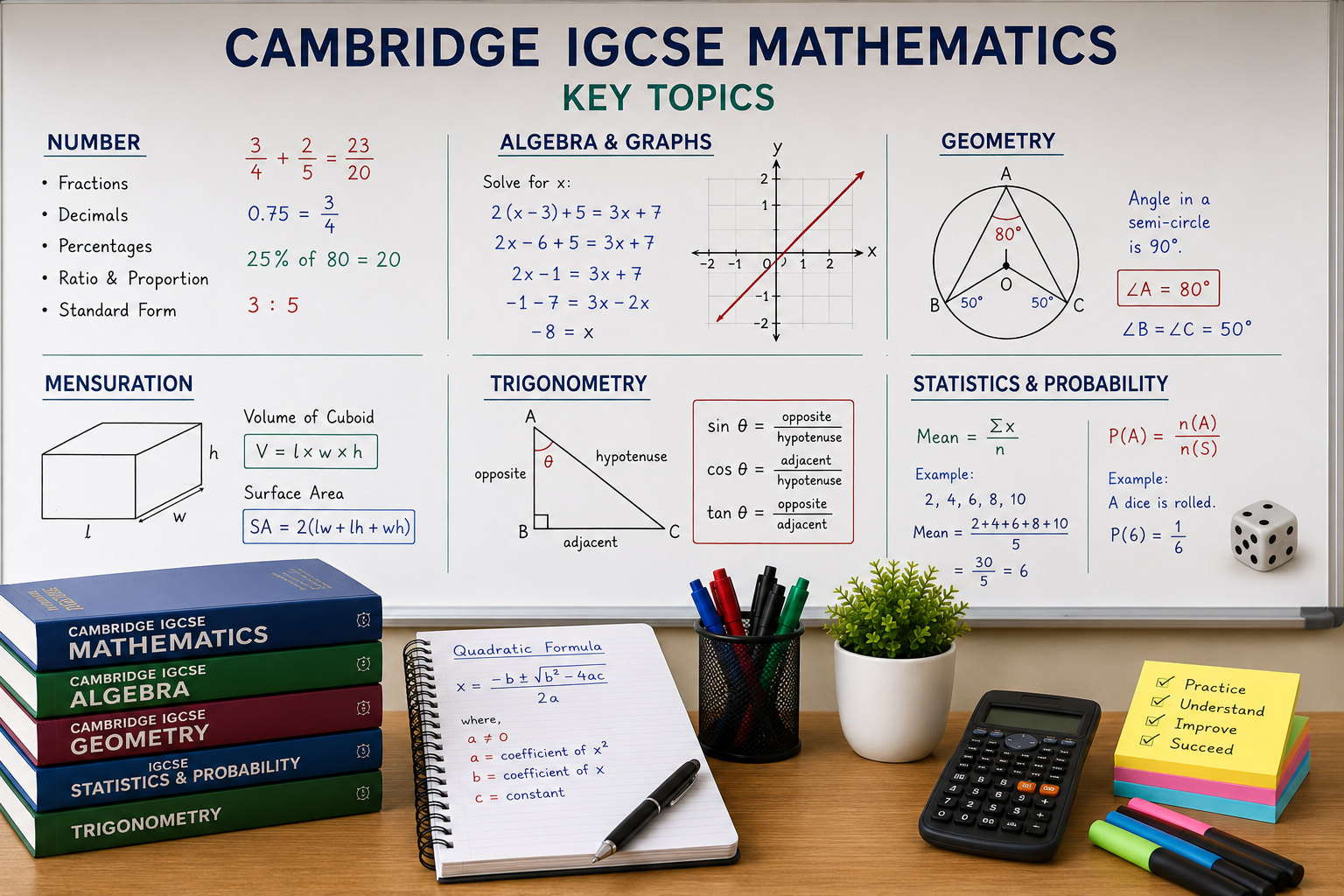
Number
Number topics can include calculations, fractions, decimals, percentages,
ratios, powers, roots, standard form, approximation, and numerical
reasoning.
Strong number skills are important because they support many other areas of
Cambridge IGCSE Mathematics.
Algebra and Graphs
Algebra is an important part of IGCSE Mathematics. Students may work with
expressions, equations, inequalities, sequences, functions, graphs, and
algebraic manipulation.
Regular algebra practice can help students become more comfortable with
multi-step problems.
Geometry
Geometry involves properties of shapes, angles, lines, circles, polygons,
transformations, and geometric reasoning.
Students should focus on understanding why a particular theorem or method
applies instead of simply memorizing isolated formulas.
Mensuration
Mensuration involves calculating measurements such as length, area,
surface area, and volume. Students should practise identifying the correct
formula and interpreting information provided in questions.
Trigonometry
Trigonometry can involve relationships between angles and sides,
particularly in right-angled triangles. Students should understand when
different trigonometric relationships are appropriate and practise
applying them to examination questions.
Statistics and Probability
Statistics and probability require students to interpret information,
understand data, calculate appropriate measures, and reason about
probability.
Functions and Sequences
Students may also encounter functions, sequences, patterns, and
relationships between variables depending on the specific syllabus.
How to Study Cambridge IGCSE Mathematics Effectively
Effective Cambridge IGCSE Mathematics preparation is
based on understanding, practice, revision, and feedback. Instead of
studying every topic in exactly the same way, students should identify
their strengths and weaknesses and adjust their study approach accordingly.
Build Strong Mathematical Foundations
Before moving to advanced problems, make sure the underlying concepts are
clear. For example, algebraic manipulation and numerical skills can be
important when solving more complicated mathematical problems.
Understand Formulas and Methods
Memorizing a formula is useful, but understanding when and how to use it is
even more important. Students should practise identifying the information
given in a question and deciding which mathematical method is appropriate.
Practise Different Question Types
Do not practise only questions that look familiar. Include straightforward,
multi-step, application-based, and unfamiliar questions in your study
routine.
Maintain a Formula and Mistake Notebook
Keep important formulas and frequently repeated mistakes in one place.
Reviewing these notes regularly can make revision more efficient.
Revise Difficult Topics Regularly
If a particular topic is difficult, do not avoid it. Instead, break it into
smaller concepts, practise basic questions first, and gradually move to
more challenging problems.
10 Cambridge IGCSE Mathematics Study Tips
1. Understand the Concept First
Before solving many questions, make sure you understand the mathematical
principle behind the problem.
2. Practise Every Day
Consistent practice is usually more effective than attempting a large
number of questions immediately before an examination.
3. Show Your Working Clearly
Develop the habit of showing appropriate steps when solving problems.
Clear working can make it easier to identify errors during revision.
4. Learn From Mistakes
Do not simply check whether an answer is right or wrong. Understand why an
error occurred and practise a similar question afterward.
5. Memorize Important Formulas Correctly
Keep a concise formula sheet and revise it regularly. However, make sure
you also understand how each formula is applied.
6. Practise Without Looking at Solutions
Attempt questions independently before checking the solution. This gives
you a more accurate understanding of your current ability.
7. Use Timed Practice
Once you become comfortable with individual topics, practise answering
questions within a realistic time limit.
8. Review Weak Topics More Frequently
Spend additional time on topics where your accuracy or confidence is lower.
At the same time, continue revising topics you already understand.
9. Use Past Papers Strategically
Past papers can help you become familiar with examination-style questions,
timing, and question formats. Use them as both a practice tool and an
assessment tool.
10. Maintain a Consistent Revision Routine
Create a realistic weekly routine that includes concept learning, question
practice, revision, past papers, and rest.
How to Use IGCSE Maths Past Papers Effectively
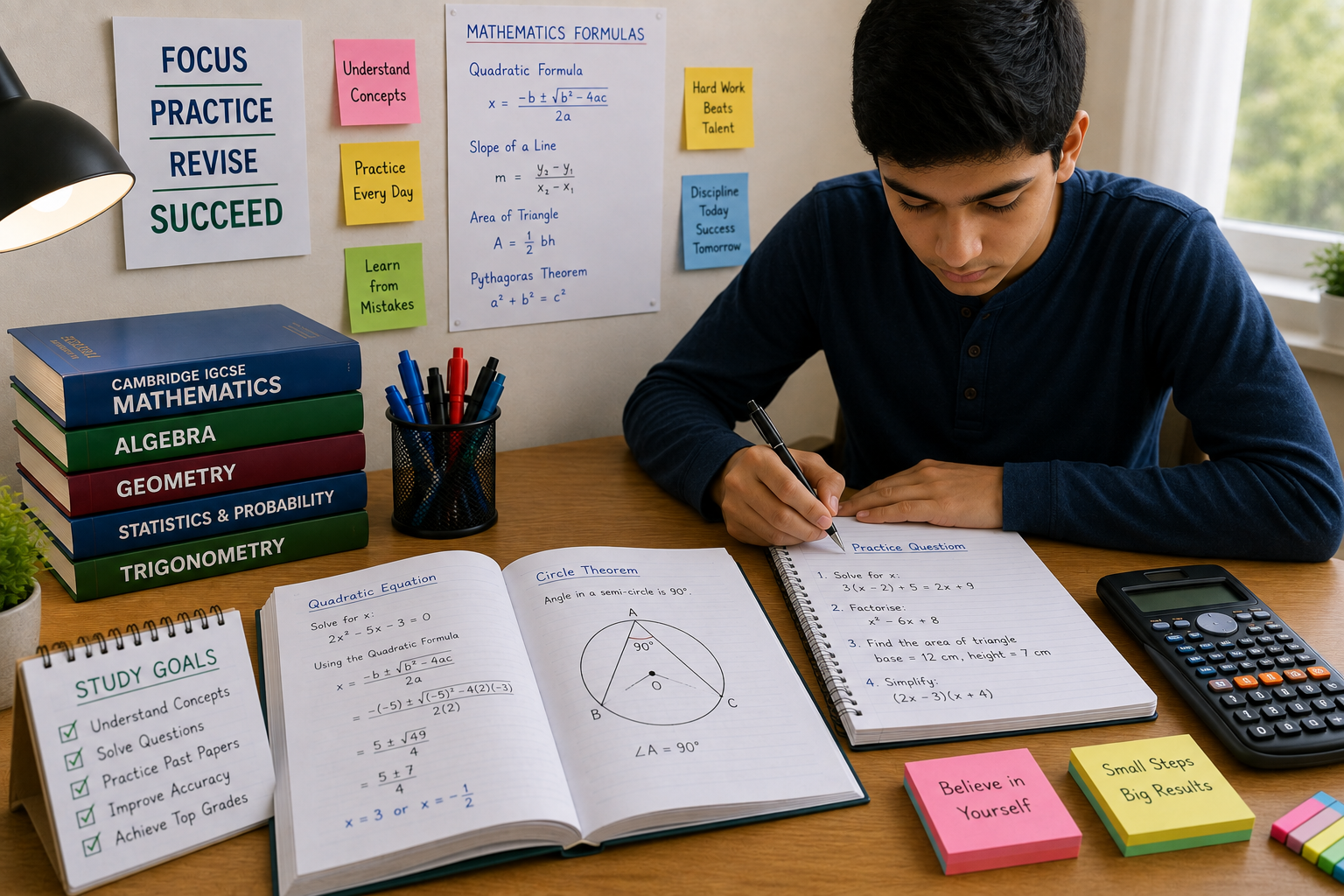
IGCSE Maths Past Papers can be an important part of
examination preparation. However, students should use them thoughtfully
rather than simply completing papers one after another.
Start With Topic-Based Questions
If you are still learning the syllabus, practise questions related to
individual topics first. This allows you to identify gaps in specific
concepts.
Move to Complete Papers
Once you have covered most topics, start attempting complete papers under
timed conditions. This helps develop examination stamina and time
management.
Check Your Working
When reviewing answers, look beyond the final result. Check your method,
calculations, substitutions, units where relevant, and interpretation of
the question.
Maintain a Mistake Log
Record recurring errors in a notebook. For example, you may notice repeated
mistakes involving signs, algebraic manipulation, formulas, units, or
reading graphs.
Revisiting these patterns can make your IGCSE Maths Exam
Preparation more targeted.
Common IGCSE Mathematics Mistakes Students Should Avoid
Many students lose marks not because they completely misunderstand a topic,
but because of avoidable errors. Therefore, identifying these mistakes can
be an important part of Cambridge IGCSE Mathematics
preparation.
- Not reading the complete question carefully
- Using the wrong formula
- Making avoidable calculation errors
- Forgetting negative signs
- Rounding too early
- Not checking whether an answer is reasonable
- Skipping important working steps
- Spending too much time on one difficult question
- Ignoring graphs, diagrams, or information provided in the question
- Practising only familiar questions
Instead, students should develop a habit of reading carefully, planning
their approach, showing appropriate working, and checking answers whenever
time allows.
How to Prepare for the Cambridge IGCSE Mathematics Exam
Before the Exam
Review important concepts, formulas, common mistakes, and difficult topics.
Complete timed practice papers and identify the areas that still require
attention.
During the Final Revision
Avoid attempting to learn the entire syllabus from the beginning again.
Instead, focus on targeted revision based on your practice performance.
The Day Before the Exam
Keep revision light and organized. Review important formulas and concepts,
prepare the required examination materials, and make sure you get adequate
rest.
During the Examination
Read questions carefully and identify what is being asked before beginning
calculations. Manage your time throughout the paper and avoid spending too
long on a single problem.
If a question appears difficult, move forward when appropriate and return
to it later if time permits.
How an IGCSE Maths Tutor Can Help Students
Some students can prepare independently, while others may benefit from
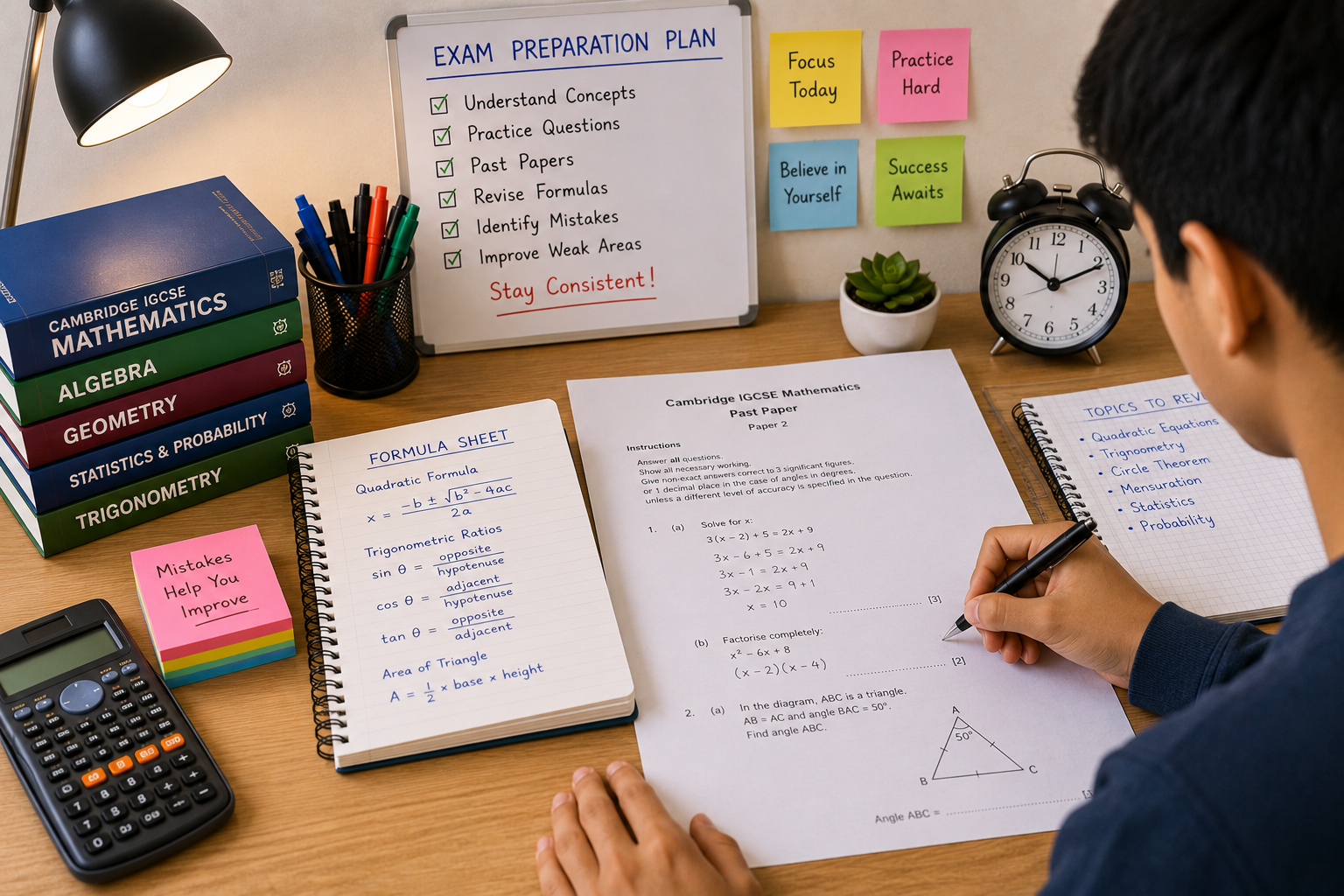
additional guidance. An experienced IGCSE Maths Tutor can
help identify learning gaps, explain difficult concepts, provide practice,
and give feedback on problem-solving methods.
Personalized support can be particularly useful when a student repeatedly
struggles with the same topic despite independent practice.
Identifying Learning Gaps
A tutor can assess which concepts require additional attention and help
the student prioritize them.
Explaining Difficult Concepts
Different students may understand the same concept through different
explanations. A tutor can use alternative examples, visual approaches, or
step-by-step problem solving when needed.
Providing Targeted Practice
Instead of assigning random questions, an IGCSE Maths tutor can focus
practice on areas where the student needs improvement.
Exam Preparation Support
Tutors can also support students with revision planning, timed practice,
past-paper analysis, and examination techniques.
Cambridge IGCSE Mathematics Online Tuition
Cambridge IGCSE Mathematics Online Tuition can provide
students with flexible access to personalized academic support. Instead of
travelling to a physical tuition centre, students can learn from home
through live online sessions.
One-to-one online tuition can allow the tutor to focus specifically on the
student’s current level, difficult topics, questions, and academic goals.
However, tuition should complement independent study. Students should
continue practising questions, revising concepts, and using appropriate
learning resources between sessions.
If you are looking for guidance on choosing an appropriate tutor, read our
related article:
How to Choose the Best IGCSE Online Tutor for Your Child
.
A Simple Weekly IGCSE Mathematics Study Plan
A balanced weekly routine can make Cambridge IGCSE Mathematics
Exam Preparation more manageable. The exact schedule should be
adjusted according to the student’s school timetable and individual needs.
| Study Activity | Main Goal |
|---|---|
| Concept Study | Understand new or difficult mathematical concepts |
| Daily Practice | Solve different question types |
| Formula Revision | Review important formulas and methods |
| Mistake Review | Identify and correct recurring errors |
| Past Paper Practice | Develop examination skills and time management |
| Weak Topic Revision | Strengthen areas requiring additional attention |
| Rest | Maintain concentration and a healthy study routine |

Frequently Asked Questions About Cambridge IGCSE Mathematics
Is Cambridge IGCSE Mathematics difficult?
The difficulty of Cambridge IGCSE Mathematics can vary
from student to student. Students who build strong foundations, practise
consistently, and address learning gaps early can approach the subject
more confidently.
How can I improve my IGCSE Maths marks?
Focus on conceptual understanding, regular practice, past papers, mistake
analysis, time management, and targeted revision of weaker topics.
Are IGCSE Maths past papers useful?
Yes. Past papers can help students practise examination-style questions,
understand question formats, improve time management, and identify areas
requiring further revision.
How early should I start preparing for IGCSE Mathematics?
Students should begin structured preparation early enough to understand
the syllabus, practise questions, revise difficult concepts, and complete
timed papers without relying on last-minute study.
Can I study Cambridge IGCSE Mathematics online?
Yes. Students can receive online academic support through live tutoring
sessions. The suitability of online tuition depends on the student’s
learning requirements, tutor expertise, and preferred learning approach.
Is one-to-one IGCSE Maths tuition useful?
One-to-one tuition can provide personalized attention and allow the tutor
to focus on the student’s individual learning gaps, questions, pace, and
academic goals.
How can IGCSE Maths students prepare for exams?
Students can prepare by understanding the syllabus, building strong
concepts, practising different question types, revising regularly, using
past papers, analysing mistakes, and completing timed mock examinations.
Improve Your Cambridge IGCSE Mathematics Preparation With EduEnrich Global
Strong performance in mathematics develops through consistent practice,
conceptual understanding, effective revision, and the right academic
guidance. If your child needs additional support, EduEnrich Global can help
students explore personalized online learning options based on their
curriculum, grade, subject requirements, and learning goals.
With Cambridge IGCSE Online Tuition, students can receive
focused support for difficult concepts, question practice, revision,
examination preparation, and academic improvement.
Discuss Your Child’s Learning Requirements
You can also explore
EduEnrich Global’s curriculum programs
to learn more about available academic support.
Explore More EduEnrich Global Resources
Official Cambridge IGCSE Mathematics Information
For official information about Cambridge IGCSE Mathematics, curriculum
requirements, syllabus details, and assessment information, students and
parents should refer to Cambridge International.
Personalized Cambridge IGCSE Mathematics Support
Personalized academic support can help students focus on difficult
mathematical concepts, practice questions, and individual learning gaps.
Consistent Practice Builds Mathematical Confidence
Regular practice, revision, mistake analysis, and structured preparation
can help students become more confident with Cambridge IGCSE Mathematics.