
Cambridge IGCSE Physics helps students understand how the
physical world works through concepts such as motion, forces, energy,
electricity, waves, thermal physics, atomic physics, and space physics.
However, preparing for IGCSE Physics requires more than memorizing formulas.
Students need to understand concepts, apply equations, interpret data,
solve numerical problems, analyse experiments, and practise examination
questions.
A successful approach to Cambridge IGCSE Physics combines
conceptual understanding with mathematical skills, practical knowledge,
regular revision, and examination practice.
Whether a student is beginning the course or preparing for final
examinations, this complete guide explains the major areas of IGCSE Physics,
effective study strategies, practical skills, past-paper preparation,
common mistakes, and ways to approach the examination with greater
confidence.
What Is Cambridge IGCSE Physics?
Cambridge IGCSE Physics is a Cambridge International
qualification that develops students’ understanding of fundamental physics
principles and their applications in the world around them.
The course also places emphasis on scientific and practical skills.
Consequently, students need to learn not only theoretical concepts but also
how to interpret evidence, perform calculations, analyse information, and
understand experimental procedures.
The exact content and assessment requirements depend on the syllabus and
syllabus year followed by the student. Therefore, students should always
use the current syllabus applicable to their examination session.
For official information about Cambridge IGCSE Physics, students and
parents can refer to
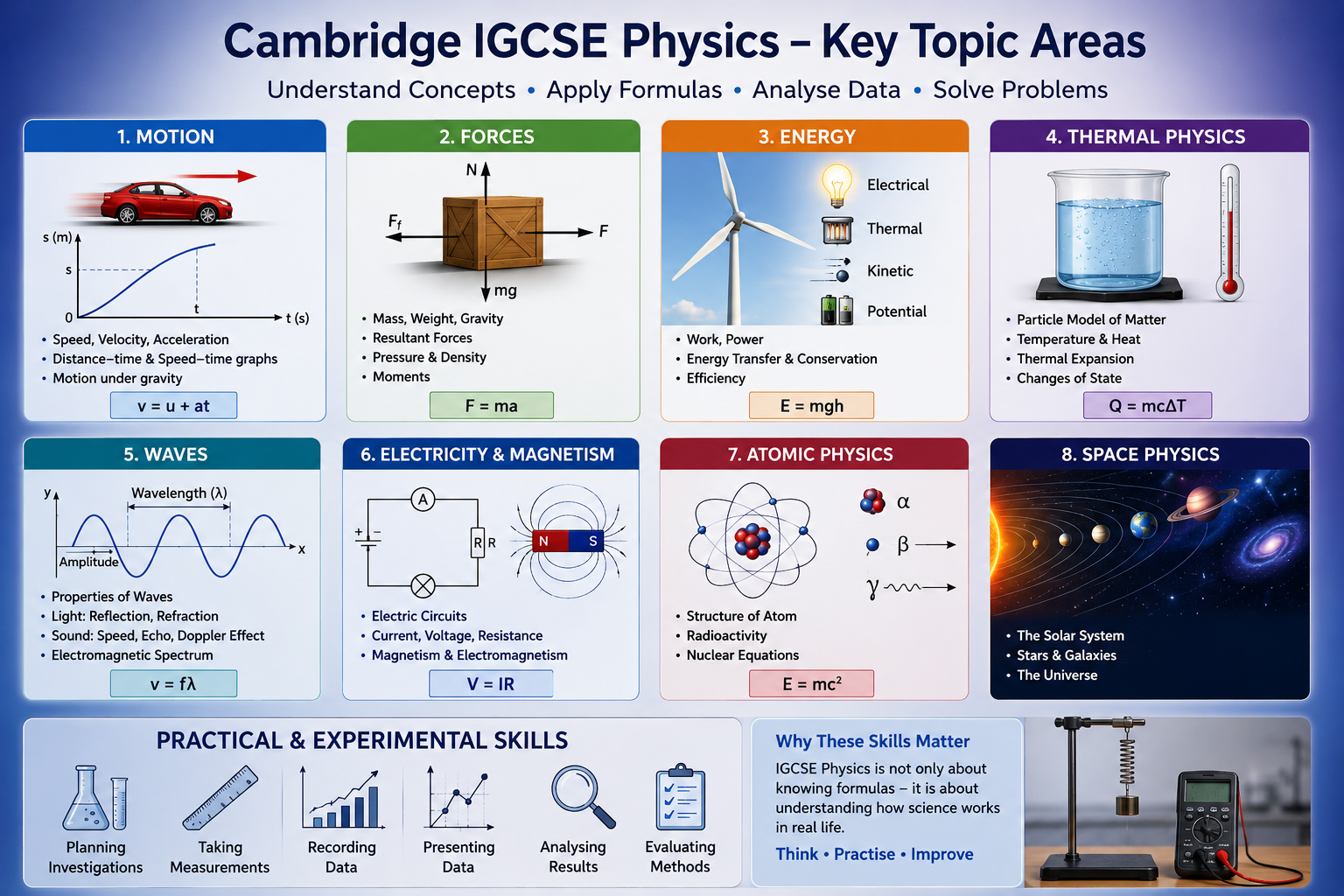
Understanding the Cambridge IGCSE Physics Syllabus
Before beginning serious IGCSE Physics Exam Preparation,
students should understand the major areas included in their syllabus.
This makes it easier to divide the subject into manageable sections and
create an effective revision plan.
Motion
Motion involves concepts such as speed, velocity, acceleration,
distance-time graphs, speed-time graphs, and motion under gravity.
Students should understand the equations as well as how to interpret
graphs and apply the concepts to different situations.
Mass, Weight and Forces
Students learn about mass, weight, gravitational field strength, forces,
moments, pressure, and related physical concepts. Understanding the
difference between mass and weight is particularly important.
Energy, Work and Power
Energy, work, power, and energy transfers are important areas of
Cambridge IGCSE Physics. Students should understand
equations and also be able to explain energy changes in physical systems.
Thermal Physics
Thermal physics covers ideas related to the particle model, temperature,
thermal properties, and thermal processes. Students should understand how
particles behave and how thermal energy is transferred.
Waves
Waves include topics such as wave properties, light, sound, reflection,
refraction, and the electromagnetic spectrum. Diagrams and practical
examples can make these concepts easier to understand.
Electricity and Magnetism
Electricity and magnetism include electrical quantities, circuits,
electrical safety, magnetic effects, and electromagnetic effects.
Students should practise drawing and interpreting circuit diagrams as
well as solving numerical problems.
Atomic Physics
Atomic physics includes the structure of the atom and radioactivity.
Students should understand the relevant terminology and be able to apply
concepts to questions and data.
Space Physics
Space physics introduces students to concepts related to stars, galaxies,
the Solar System, and the wider universe. It combines scientific
understanding with interpretation of information about astronomical
systems.
How to Study Cambridge IGCSE Physics Effectively
Effective Cambridge IGCSE Physics preparation requires a
combination of understanding, application, practice, and revision.
Memorizing definitions and equations alone is rarely enough.
Understand Concepts Before Memorizing
First, understand what a physical concept means and how it works. Once the
concept is clear, formulas and definitions become easier to remember and
apply.
Learn How Physics Equations Work
Students should understand what each quantity represents, the appropriate
units, and when an equation should be used. Practise rearranging equations
when necessary and always check whether the final answer is reasonable.
Practise Numerical Problems
Physics often combines scientific concepts with mathematical calculations.
Therefore, solve numerical questions regularly instead of postponing them
until examination time.
Draw and Interpret Diagrams
Diagrams can help explain forces, circuits, waves, rays, magnetic fields,
and experimental arrangements. Practise both drawing and interpreting
relevant diagrams.
Review Practical Experiments
Practical skills are an important part of the Cambridge Physics experience.
Students should understand experimental procedures, variables,
measurements, observations, data handling, and evaluation.
10 Cambridge IGCSE Physics Study Tips
1. Understand the Syllabus
Begin by identifying the topics and learning objectives included in your
current syllabus.
2. Build Strong Foundations
Make sure fundamental concepts are clear before moving to more complicated
applications.
3. Create a Formula Sheet
Keep important equations in one place and revise them regularly. Also
remember the meaning and units of each quantity.
4. Practise Numerical Questions
Solve numerical problems regularly and write the relevant equation before
substituting values.
5. Learn Physics Definitions Carefully
Important definitions should be understood and revised carefully because
precise scientific language matters.
6. Use Diagrams
Use labelled diagrams to understand forces, circuits, rays, waves,
experiments, and other physical systems.
7. Practise Data Interpretation
Learn how to read tables, graphs, measurements, and experimental results.
Data interpretation can connect theoretical knowledge with practical
situations.
8. Review Practical Skills
Understand how experiments are planned, measured, recorded, and evaluated.
Pay attention to variables, accuracy, reliability, and sources of error.
9. Use Past Papers
Past papers can help students become familiar with examination-style
questions, command words, timing, and common question formats.
10. Analyse Your Mistakes
Do not simply mark an answer as incorrect. Identify the reason for the
mistake and revisit the underlying concept before attempting a similar
question again.
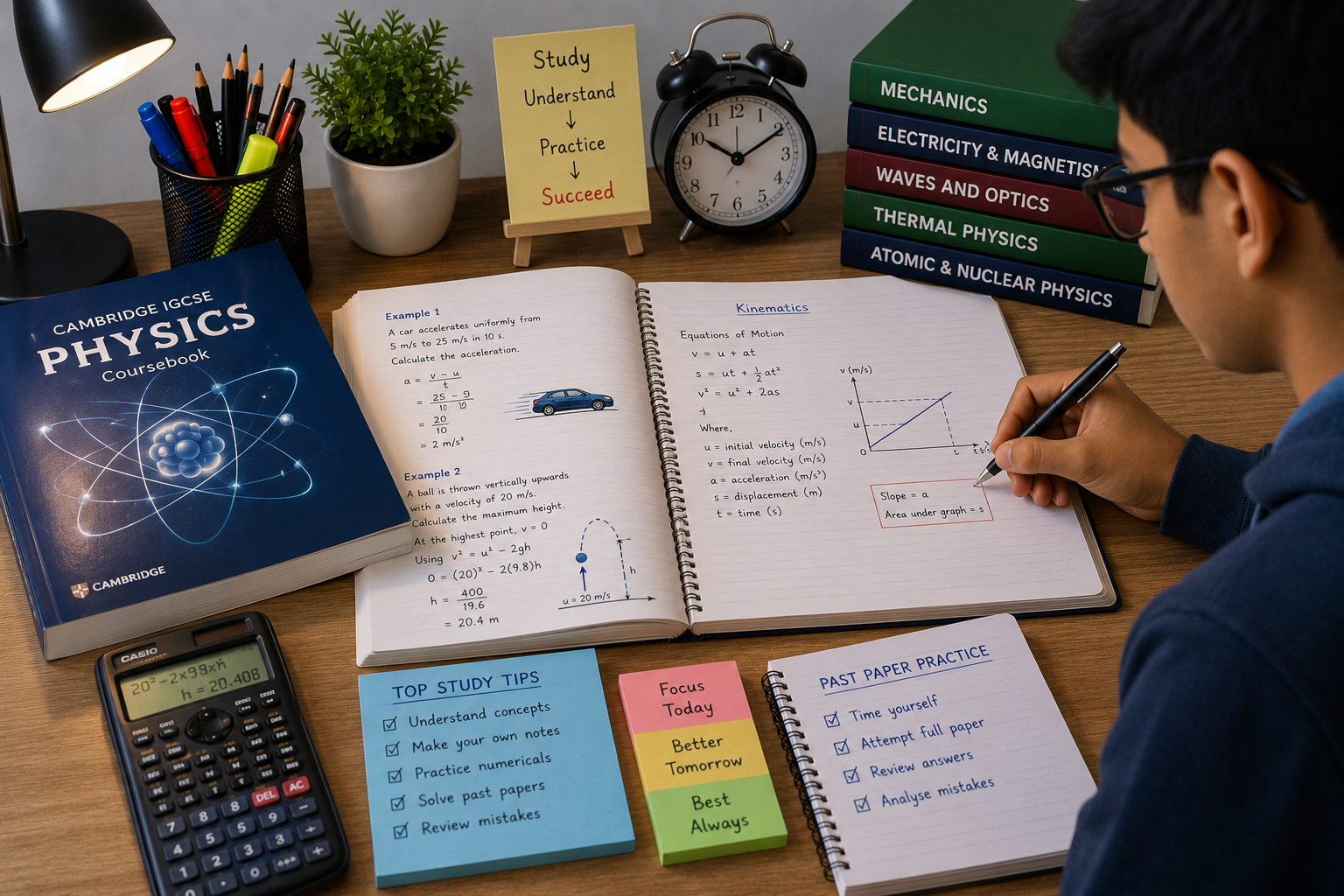
How to Use IGCSE Physics Past Papers Effectively
IGCSE Physics Past Papers can be an important part of
examination preparation. However, students should use them strategically
rather than simply completing papers without reviewing their performance.
Start With Topic-Based Questions
While learning the syllabus, begin with questions related to individual
topics. This helps students identify specific knowledge gaps.
Practise Calculations Separately
Spend additional time on numerical questions involving formulas, units,
graphs, and calculations.
Move to Complete Papers
Once the majority of topics are understood, attempt complete papers under
timed conditions. This helps students develop examination stamina and
time-management skills.
Analyse Every Error
After completing a paper, classify mistakes. For example, determine whether
the problem came from a concept gap, calculation error, unit conversion,
misreading the question, or insufficient explanation.
Reattempt Difficult Questions
After reviewing a mistake, solve a similar question again without looking
at the answer. This turns mistakes into useful revision opportunities.
Common IGCSE Physics Mistakes Students Should Avoid
Students can sometimes lose marks because of avoidable errors rather than
a complete lack of understanding. Therefore, developing careful habits is
an important part of Cambridge IGCSE Physics preparation.
- Memorizing formulas without understanding them
- Forgetting or using incorrect units
- Substituting values into the wrong equation
- Rounding answers too early
- Not reading command words carefully
- Ignoring information shown in diagrams or graphs
- Confusing mass with weight
- Failing to explain practical procedures clearly
- Not checking calculations
- Practising only familiar questions
Instead, students should develop a habit of identifying what the question
is asking, selecting the appropriate concept or equation, showing suitable
working, and checking the final answer.
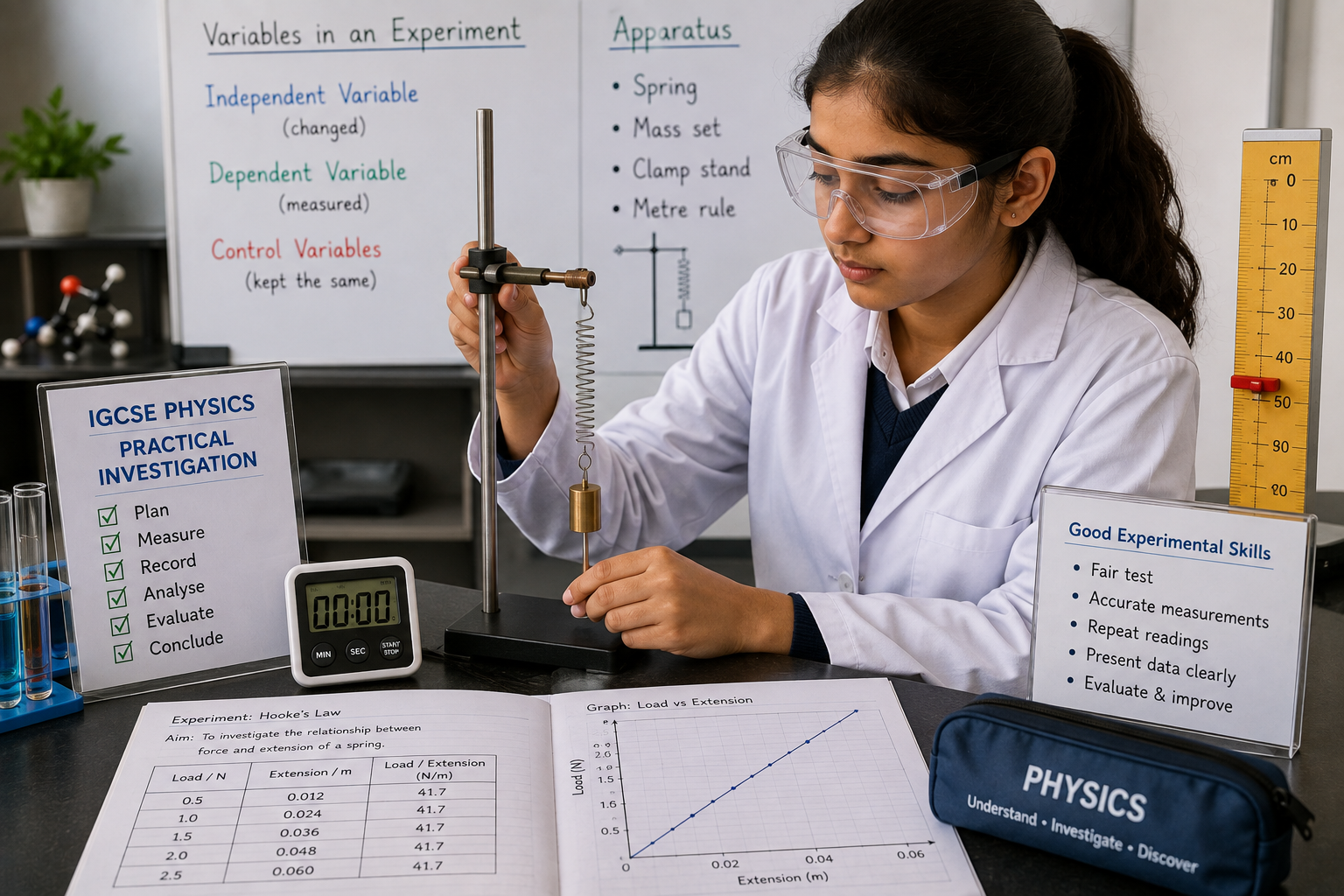
Practical Skills in Cambridge IGCSE Physics
Practical and experimental skills are an important part of
Cambridge IGCSE Physics. Students should therefore
understand how scientific investigations are planned and evaluated.
Understanding Variables
Students should be able to identify variables that are changed, measured,
and controlled in an investigation.
Taking Measurements
Learn how to record measurements appropriately and consider the precision
and limitations of measuring instruments.
Presenting Data
Practise recording data in tables and representing appropriate information
using graphs.
Interpreting Results
Students should be able to identify patterns, describe relationships, and
use evidence from an experiment to support conclusions.
Evaluating Experiments
Think about reliability, limitations, sources of error, and how an
investigation could be improved.
Cambridge’s current Physics materials specifically emphasize practical
skills and scientific skills alongside subject knowledge.
How to Prepare for the Cambridge IGCSE Physics Exam
Before the Exam
Review the syllabus, important definitions, equations, diagrams,
experiments, and difficult topics. Complete practice questions and timed
papers to identify areas that still need attention.
During Final Revision
Focus on your weaker areas rather than repeatedly revising topics that you
already know well. Use your mistake notebook to guide the final revision.
Practise Under Time Limits
Timed practice can help students understand how to manage the available
examination time while still giving sufficient attention to calculations
and explanations.
Review Units and Equations
Before the examination, review common equations and the units associated
with physical quantities.
Read Questions Carefully
During the examination, identify exactly what is being asked before
selecting an equation or writing an explanation.
Check Your Answers
If time permits, review calculations, units, significant figures where
applicable, diagrams, and explanations before submitting the paper.
How an IGCSE Physics Tutor Can Help Students
Some students are comfortable preparing independently, while others benefit
from additional academic guidance. An experienced
IGCSE Physics Tutor can help identify learning gaps,
explain difficult concepts, provide targeted practice, and review mistakes.
Identifying Conceptual Gaps
A tutor can help identify whether a student’s difficulty comes from a
missing foundation, incorrect application of a formula, mathematical
weakness, or misunderstanding of the physical concept.
Simplifying Difficult Concepts
Physics can become easier to understand when abstract ideas are connected
to everyday examples, diagrams, experiments, and step-by-step reasoning.
Supporting Numerical Practice
Students can receive targeted support with equations, substitutions,
units, graphs, and multi-step calculations.
Supporting Examination Preparation
A tutor can also help students organize revision, analyse past papers,
practise timed questions, and identify recurring mistakes.
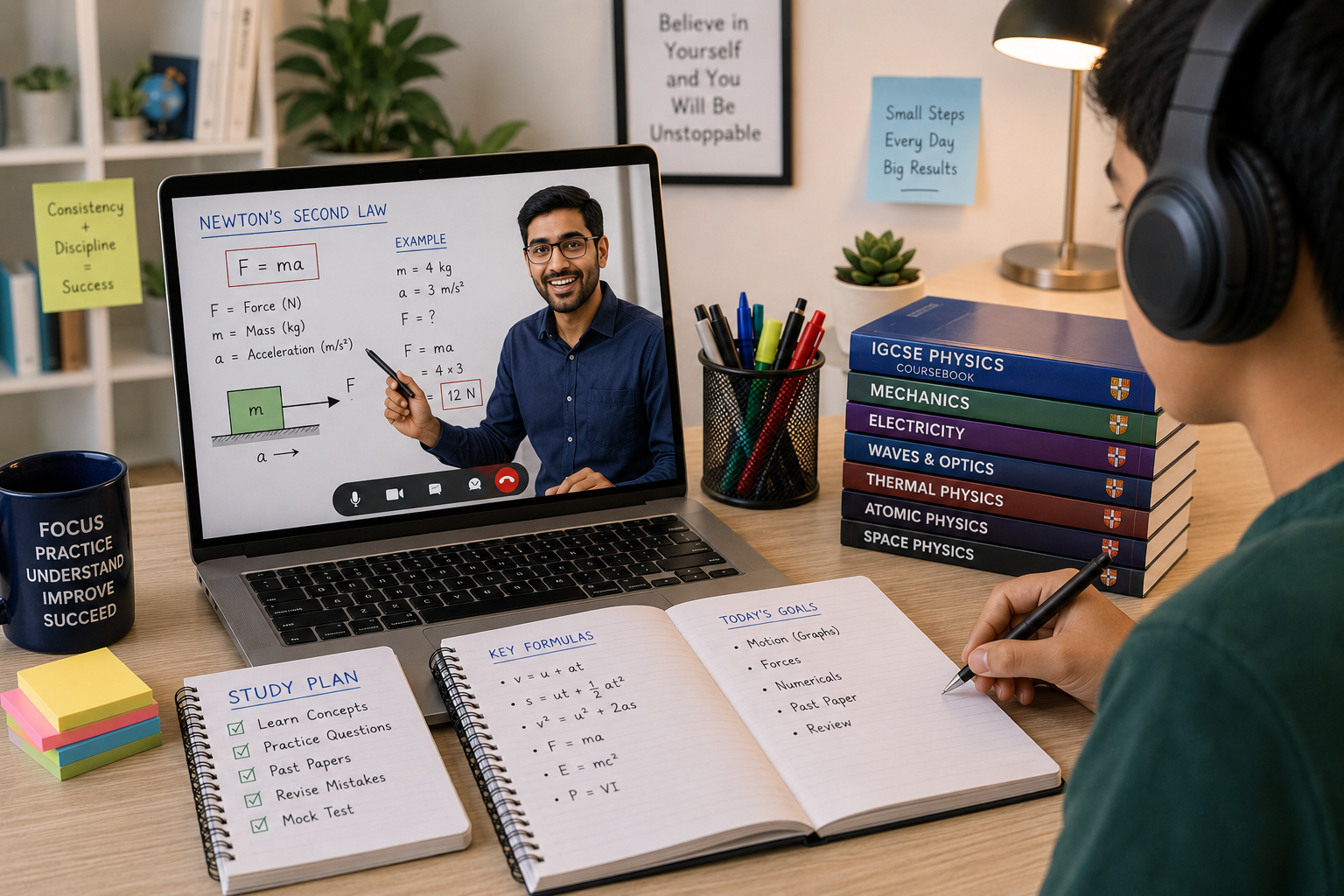
Cambridge IGCSE Physics Online Tuition
Cambridge IGCSE Physics Online Tuition can provide
students with flexible access to personalized academic support. Live online
lessons allow students to study from home while receiving focused guidance
in areas where they need additional help.
One-to-one online tuition can be particularly useful when a student needs
additional time to understand a concept, practise numerical problems,
review practical skills, or prepare for examinations.
However, tuition should complement independent learning. Students should
continue practising questions, revising concepts, and reviewing their
mistakes between lessons.
If you are looking for guidance on selecting an appropriate tutor, read:
A Simple Weekly Cambridge IGCSE Physics Study Plan
A balanced weekly routine can make
Cambridge IGCSE Physics Exam Preparation more manageable.
The exact schedule should be adjusted according to the student’s school
workload and individual learning needs.
| Study Activity | Main Goal |
|---|---|
| Concept Study | Understand new physics concepts |
| Formula Practice | Apply equations correctly |
| Numerical Questions | Improve calculation and application skills |
| Diagram Practice | Strengthen visual and scientific explanations |
| Practical Revision | Review experiments, variables and data handling |
| Past Papers | Develop examination technique |
| Mistake Review | Identify and correct recurring errors |
| Rest | Maintain concentration and a healthy routine |
Frequently Asked Questions About Cambridge IGCSE Physics
Is Cambridge IGCSE Physics difficult?
The difficulty of Cambridge IGCSE Physics varies between
students. Strong conceptual understanding, regular practice, mathematical
skills, and early revision can make the subject more manageable.
How can I improve my IGCSE Physics marks?
Focus on understanding concepts, practising numerical problems, revising
definitions and equations, completing past papers, reviewing practical
skills, and analysing mistakes.
Are IGCSE Physics past papers useful?
Yes. Past papers can help students practise examination-style questions,
improve time management, identify recurring question types, and discover
areas that need further revision. Cambridge also provides selected past
papers and specimen examinations through its Physics resources.
How early should I start preparing for IGCSE Physics?
Students should begin structured preparation early enough to understand
the syllabus, practise questions, revise difficult concepts, and complete
timed papers without depending on last-minute study.
Is practical knowledge important in IGCSE Physics?
Yes. Practical and scientific skills are an important part of Cambridge
IGCSE Physics. Students should understand measurements, variables,
experimental procedures, data presentation, interpretation, and
evaluation.
Can I study Cambridge IGCSE Physics online?
Yes. Students can receive live online academic support from an appropriate
IGCSE Physics tutor. The suitability of online tuition depends on the
student’s learning needs, tutor expertise, and preferred learning approach.
Is one-to-one IGCSE Physics tuition useful?
One-to-one tuition can provide personalized attention and allow the tutor
to focus on individual learning gaps, numerical problems, practical
concepts, revision needs, and examination preparation.
Improve Your Cambridge IGCSE Physics Preparation With EduEnrich Global
Strong performance in physics develops through conceptual understanding,
mathematical application, practical awareness, regular practice, and
effective revision. If your child needs additional academic support,
EduEnrich Global can help explore personalized learning options based on
the student’s curriculum, grade, subject requirements, and learning goals.
With Cambridge IGCSE Online Tuition, students can receive
focused support for difficult concepts, numerical problems, practical
skills, revision, question practice, and examination preparation.
Discuss Your Child’s Learning Requirements
You can also explore
EduEnrich Global’s curriculum programs
to learn more about available academic support.
Explore More EduEnrich Global Resources
Official Cambridge IGCSE Physics Resources
For the latest syllabus information, assessment details, and official
Cambridge resources, students and parents should use Cambridge
International’s official Physics page.
Visit Official Cambridge IGCSE Physics
Students can also access Cambridge’s official selection of
Personalized Cambridge IGCSE Physics Support
Personalized academic support can help students focus on difficult physics
concepts, numerical problems, practical skills, and examination preparation.
Understand Physics, Practise Regularly, Improve With Feedback
Consistent concept learning, numerical practice, practical revision,
mistake analysis, and past-paper preparation can help students become more
confident with Cambridge IGCSE Physics.