
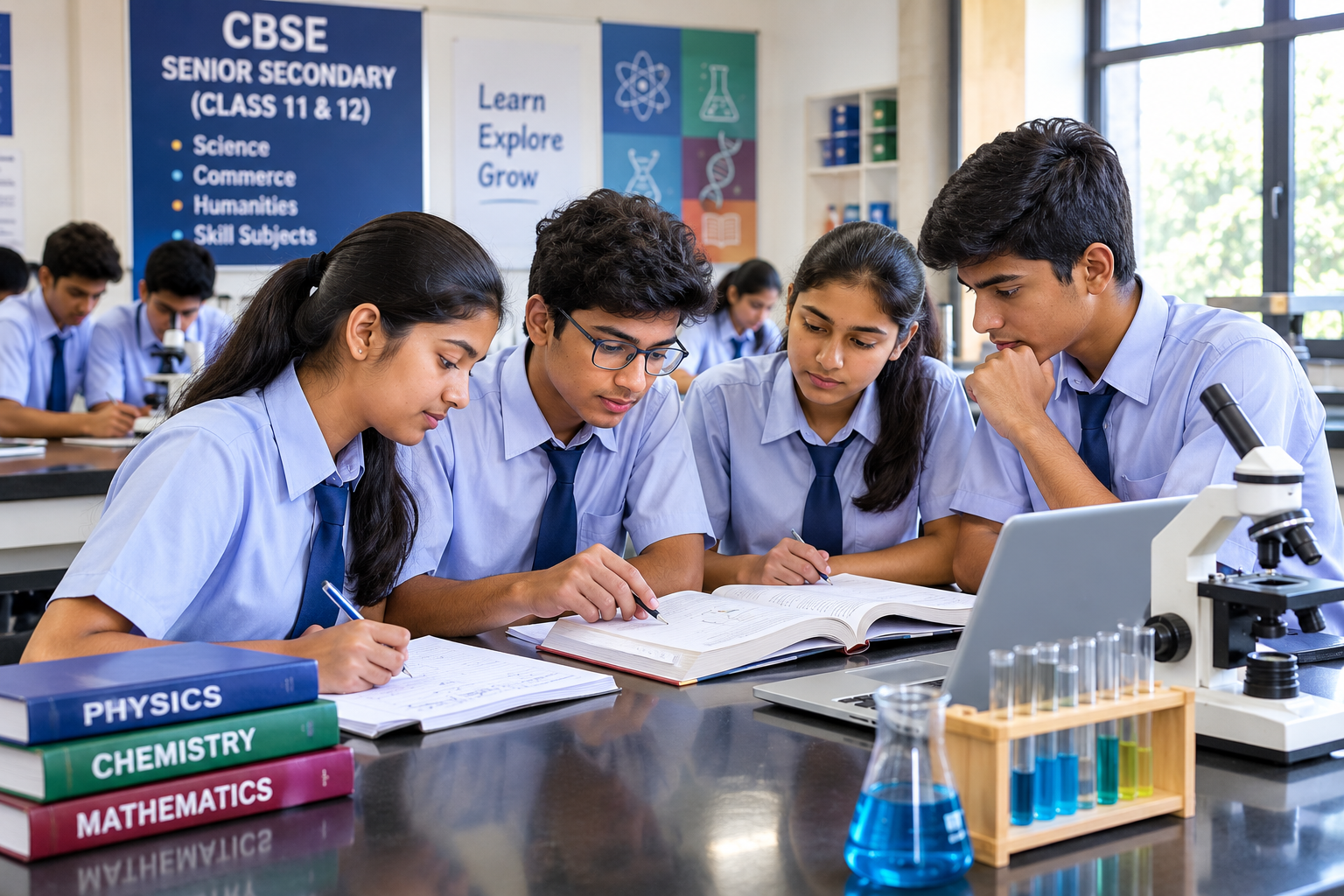
CBSE Syllabus 2026–27: Complete Guide for Classes 10, 11 & 12
The CBSE Syllabus 2026–27 has been released for Classes 9 to 12, bringing important curriculum and assessment developments for students across the secondary and senior secondary stages.
For students in Classes 10, 11 and 12, understanding the latest CBSE curriculum is important because each class follows a different academic and examination structure. Class 10 students also need to understand the new two-Board-Examination system introduced from the 2026 examinations, while Classes 11 and 12 follow the Senior Secondary Curriculum with subject-specific academic, practical, project and internal-assessment requirements.
This guide explains the CBSE Syllabus 2026–27, important curriculum developments, examination structure, assessment components, practical requirements, skill subjects and what students and parents should know before beginning the academic year.
CBSE Syllabus 2026–27: Quick Overview
- Classes covered: 9, 10, 11 and 12
- Class 10: Secondary curriculum with the two-Board-Examination system introduced from the 2026 examinations
- Class 11: Senior Secondary curriculum with school-level assessment
- Class 12: Senior Secondary curriculum and CBSE Board Examination
- Assessment: Theory, internal assessment, practicals and projects depending on the subject
- Learning focus: Conceptual understanding, application, reasoning, competency and problem-solving
- Skill education: CBSE continues to offer a wide range of vocational and career-oriented subjects
Table of Contents
- What Is the CBSE Syllabus 2026–27?
- What Has Changed in CBSE 2026–27?
- CBSE Class 10 Syllabus 2026–27
- CBSE Class 10 Two Board Examinations
- CBSE Class 11 Syllabus 2026–27
- CBSE Class 12 Syllabus 2026–27
- CBSE Assessment Pattern
- Competency-Based and Application-Oriented Learning
- Practical, Project and Internal Assessment
- CBSE Skill Subjects 2026–27
- How Students Should Prepare
- Frequently Asked Questions
What Is the CBSE Syllabus 2026–27?
The CBSE Syllabus 2026–27 provides the academic framework that schools affiliated with the Central Board of Secondary Education follow for the academic session.
CBSE has released curriculum documents covering Classes IX–XII. The curriculum includes subject-wise learning objectives, content, assessment requirements, practical or project components where applicable, and other academic guidelines.
The curriculum reflects CBSE’s broader focus on competency-based education, experiential learning, flexibility and holistic development.
Official source:
View the official CBSE Curriculum 2026–27
What Has Changed in CBSE 2026–27?
One of the most important developments for the 2026–27 academic session is the implementation of the scheme of studies recommended under the National Curriculum Framework for School Education (NCF-SE 2023) beginning with Class IX.
CBSE released the 2026–27 curriculum for Classes IX–XII in April 2026 and advised affiliated schools to follow the curriculum and guidelines provided in the official documents.
However, it is important to understand that this does not mean every subject in Classes 10, 11 and 12 has been completely replaced with a new syllabus.
Changes need to be understood according to the student’s class, subject and the applicable academic framework.
Important Note
The two-Board-Examination system for Class 10 is an examination reform implemented from the 2026 Board examinations. It should not be confused with the release of the general CBSE 2026–27 academic curriculum.
CBSE Class 10 Syllabus 2026–27
Class 10 is an important stage in the CBSE Secondary Curriculum because students prepare for their Board Examination while completing the secondary-level course.
The major academic areas include languages, Mathematics, Science and Social Science, along with additional academic, elective and skill-subject options depending on the student’s subject combination and school.
Common Class 10 Subject Areas
- Languages
- Mathematics
- Science
- Social Science
- Skill subjects
- Additional academic or language subjects where applicable
- Internal-assessment areas
Students should always refer to the subject-specific CBSE curriculum for the exact chapters, learning outcomes, marks distribution and assessment requirements.
CBSE Class 10 Two Board Examinations: What Students Need to Know
One of the most significant examination reforms affecting Class 10 students is the introduction of two Board Examinations in a school year.
CBSE implemented this policy from the 2026 examinations, following the direction of the National Education Policy 2020 to reduce the high-stakes nature of Board examinations and provide students with an additional opportunity to improve their performance.
Is the First Class 10 Board Examination Compulsory?
Yes. CBSE has clarified that students must appear in the first Board Examination.
A student cannot simply skip the first Board Examination and decide to appear only in the second examination.
Can Students Improve Their Marks in the Second Examination?
Yes. Eligible students who pass the first examination can use the second examination to improve their performance in up to three specified main subjects.
The subjects specified by CBSE for the improvement provision include:
- Science
- Mathematics
- Social Science
- Languages
What If a Student Has a Compartment Result?
Students placed in the Compartment category can appear in the second examination under the applicable Compartment provisions.
What If a Student Misses Three or More Subjects in the First Examination?
CBSE has clarified that a student who has not appeared in three or more subjects in the first examination will not be permitted to use the second examination as a replacement for the missed examination. Such students are placed in the applicable Essential Repeat category and can appear in the following year’s main examination according to CBSE rules.
Is the Full Syllabus Used for Both Examinations?
Yes. The two examinations are conducted on the full syllabus meant for the academic year, with the scheme of studies and examination scheme remaining the same.
Class 10 Two-Exam System at a Glance
| Question | CBSE Rule |
|---|---|
| Is the first exam compulsory? | Yes |
| Can eligible students improve marks? | Yes |
| How many specified main subjects can be improved? | Up to 3 |
| Is the second exam based on the full syllabus? | Yes |
| Can a student skip the first exam and write only the second? | No |
| Does the second exam apply to every student automatically? | No. Eligibility rules apply. |
Official examination information:
Read CBSE’s official clarification on the two Class 10 Board Examinations
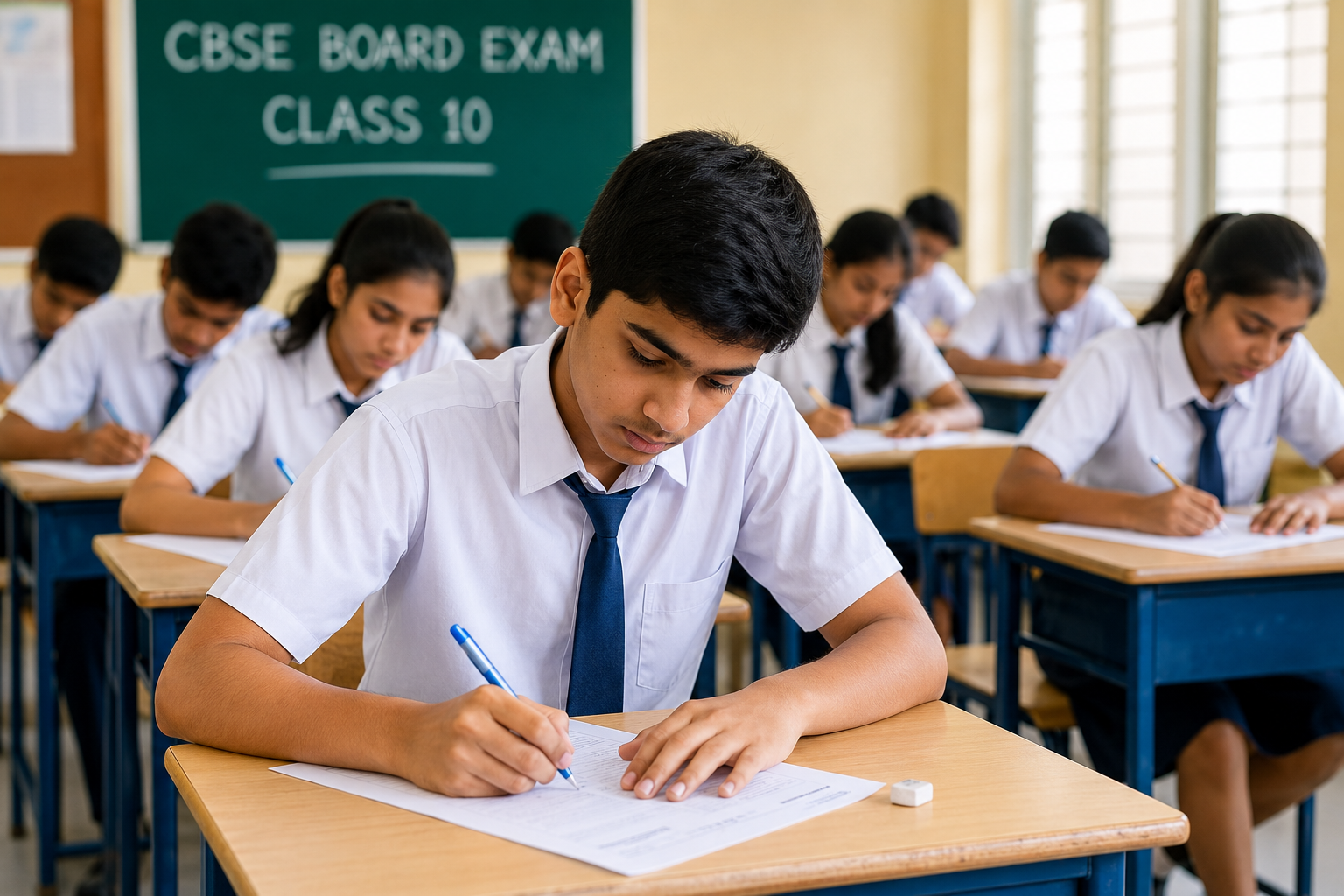
CBSE Class 11 Syllabus 2026–27
Class 11 marks the beginning of the Senior Secondary stage. Students move from the broad secondary curriculum into more specialised subjects based on their academic interests and future plans.
Unlike Class 10 and Class 12, Class 11 is not a CBSE Board Examination year. Schools conduct Class 11 examinations and assessments according to their academic schedule and the applicable CBSE curriculum.
Science Stream Subjects
- Physics
- Chemistry
- Biology
- Mathematics
- Applied Mathematics
- Computer Science
- Informatics Practices
Commerce Stream Subjects
- Accountancy
- Business Studies
- Economics
- Mathematics
- Applied Mathematics
- Entrepreneurship
- Informatics Practices
Humanities Stream Subjects
- History
- Political Science
- Geography
- Psychology
- Sociology
- Economics
- Legal Studies
- Fine Arts
The subjects and combinations available to students depend on what their individual schools offer.
Learn more:
CBSE Class 11 Syllabus 2026–27: Complete Subject-Wise Guide
CBSE Class 12 Syllabus 2026–27
Class 12 is the second major Board Examination stage in the CBSE school system. Students complete the Senior Secondary Curriculum and appear for the CBSE Class 12 Board Examination at the end of the academic session.
The 2026–27 Senior Secondary Curriculum includes academic subjects, languages, practical subjects, project-based subjects and skill-oriented options.
Popular Class 12 Subjects
- Physics
- Chemistry
- Biology
- Mathematics
- Applied Mathematics
- Accountancy
- Business Studies
- Economics
- Computer Science
- Informatics Practices
- Psychology
- Political Science
- History
- Geography
- Sociology
- Physical Education
- Entrepreneurship
- Fine Arts
- Languages
The exact subject combination depends on the student’s stream and the subjects offered by their school.
Read the detailed guide:
CBSE Class 12 Syllabus 2026–27: Complete Subject-Wise Guide
CBSE Assessment Pattern 2026–27
Assessment under CBSE is not limited to memorising textbook content. Depending on the subject and class, students may be assessed through written examinations, internal assessment, practical examinations, projects and other academic activities.
Theory Examination
Theory examinations test students on the academic content and learning outcomes specified in the relevant subject curriculum.
Internal Assessment
Internal assessment allows schools to evaluate components of learning throughout the academic year. The exact marks and activities vary according to the subject.
Practical Examination
Science and other practical-oriented subjects may include practical examinations. Students should check the subject-specific curriculum for the exact requirements.
Project Work
Some subjects include project work as part of the overall assessment. Students should complete projects according to the instructions provided by their school and the relevant CBSE subject curriculum.
Remember
There is no single theory-to-internal-assessment formula that applies identically to every CBSE subject. Always check the official curriculum for the specific subject.
Competency-Based and Application-Oriented Learning in CBSE
A major direction in the CBSE curriculum is the emphasis on competency-based learning.
Students are increasingly expected to demonstrate that they understand concepts and can apply them to unfamiliar or real-world situations.
Students May Need to:
- Apply concepts to new situations
- Analyse information
- Interpret data
- Solve problems
- Explain reasoning
- Connect different concepts
- Use knowledge in practical situations
- Evaluate information and arrive at conclusions
This means that simply memorising answers may not be sufficient for strong performance. Students should focus on understanding concepts and practising different types of questions.
Practical, Project and Internal Assessment in CBSE
Students should not focus only on the final theory examination. For subjects that include practicals, projects or internal assessment, these components can contribute to the student’s overall academic performance.
Students Should Keep Track of:
- Practical records
- Laboratory activities
- Projects
- Assignments
- Periodic assessments
- Subject-specific internal-assessment activities
- Submission deadlines
The exact assessment structure varies by subject, so students should refer to the latest subject-specific CBSE curriculum and instructions provided by their school.
CBSE Skill Subjects 2026–27
CBSE continues to provide a wide range of skill-based and vocational subjects for students in the Senior Secondary stage.
These subjects are designed to provide students with practical knowledge and exposure to areas connected with higher education, employment and emerging career opportunities.
Examples of CBSE Skill Subjects
- Artificial Intelligence
- Data Science
- Information Technology
- Retail
- Marketing
- Banking
- Healthcare
- Insurance
- Agriculture
- Tourism
- Food Production
- Multimedia
- Design
- Business Administration
- Taxation
- Cost Accounting
- Design Thinking and Innovation
- Electronics and Hardware
The availability of individual skill subjects depends on the school.
Official source:
Explore CBSE Skill Education Subjects
CBSE Classes 10, 11 and 12: Key Differences
| Feature | Class 10 | Class 11 | Class 12 |
|---|---|---|---|
| Academic Stage | Secondary | Senior Secondary | Senior Secondary |
| CBSE Board Exam | Yes | No | Yes |
| Two-Board-Exam System | Implemented from 2026 examinations | Not applicable | Not applicable |
| Subject Specialisation | Limited compared with XI–XII | Higher | Higher |
| Practical / Project | Depends on subject | Depends on subject | Depends on subject |
| Internal Assessment | Applicable | Applicable according to subject/school assessment | Applicable according to subject |
How Should Students Prepare for CBSE 2026–27?
Understanding the syllabus at the beginning of the academic year can help students create a realistic study plan instead of waiting until examinations are approaching.
1. Download the Latest Official Syllabus
Students should begin by checking the official CBSE curriculum for their class and individual subjects.
2. Understand the Marks Distribution
Identify the marks assigned to theory, practicals, projects and internal assessment where applicable.
3. Focus on Concepts
Build conceptual understanding instead of depending entirely on memorised answers.
4. Practise Application-Based Questions
Students should practise questions that require interpretation, reasoning, analysis and application.
5. Complete Internal Assessment Work on Time
Projects, practical records and other internal-assessment activities should be completed throughout the year.
6. Class 10 Students Should Understand the Two-Exam System
Students and parents should understand the rules for the first and second Board Examinations rather than assuming that the second examination is simply an optional second attempt for everyone.
7. Class 11 Students Should Plan Their Subject Choices Carefully
Class 11 introduces students to more specialised academic areas. Understanding subject requirements early can make the transition to Class 12 easier.
8. Class 12 Students Should Follow Subject-Specific Guidelines
Board preparation should be based on the latest syllabus, sample papers, marking schemes and official CBSE instructions applicable to each subject.
Frequently Asked Questions About CBSE Syllabus 2026–27
Is the CBSE syllabus changed for 2026–27?
CBSE has released the curriculum for the 2026–27 academic session, with changes and updates varying by class and subject. It is not accurate to say that the entire CBSE syllabus has been completely replaced. Students should check the official curriculum for their specific class and subject.
Will Class 10 students have two Board Exams?
CBSE implemented the two-Board-Examination system for Class 10 from the 2026 examinations. The first Board Examination is mandatory, while eligible students can use the second examination for improvement or under other applicable categories.
Can Class 10 students skip the first Board Examination?
No. CBSE has clarified that appearing in the first Board Examination is mandatory for students.
Can a Class 10 student improve marks in the second Board Examination?
Eligible students who pass the first examination can improve their performance in up to three specified main subjects under the CBSE rules.
Is the second Class 10 Board Examination based on the full syllabus?
Yes. CBSE’s scheme states that both examinations are conducted on the full syllabus meant for the academic year.
Is Class 11 a CBSE Board Examination year?
No. Class 11 is part of the Senior Secondary Curriculum, but the CBSE Board Examination is conducted at the end of Class 12.
Does every CBSE Class 11 and 12 subject have the same marks distribution?
No. Theory, practical, project and internal-assessment requirements vary according to the subject. Students should check the official curriculum for the specific subject.
Does CBSE offer skill subjects in Classes 11 and 12?
Yes. CBSE offers a wide range of skill and vocational subjects, including areas such as Artificial Intelligence, Data Science, Information Technology, Marketing, Healthcare, Tourism, Agriculture, Multimedia and Design. Availability depends on the school.
Where can students check the official CBSE syllabus?
Students should use the official CBSE Academic website and select the curriculum applicable to the relevant academic session and class.
Final Takeaway
The CBSE Syllabus 2026–27 brings important developments across the secondary and senior secondary stages. However, the changes are not identical for Classes 10, 11 and 12.
For Class 10 students, one of the most important examination developments is the two-Board-Examination system introduced from the 2026 examinations. Class 11 students move into the Senior Secondary stage with greater subject specialisation, while Class 12 students prepare for the CBSE Board Examination with subject-specific theory, practical, project and internal-assessment requirements.
Across the curriculum, students should pay attention to conceptual understanding, application, reasoning, problem-solving and competency-based learning rather than relying only on memorisation.
Since curriculum and examination rules can be updated by CBSE, students and parents should always verify the latest information using the official CBSE curriculum and examination notifications.
Looking for Academic Support?
Understanding the latest CBSE syllabus is the first step. A structured study plan, concept-based learning and regular academic support can help students prepare more confidently throughout the academic year.