
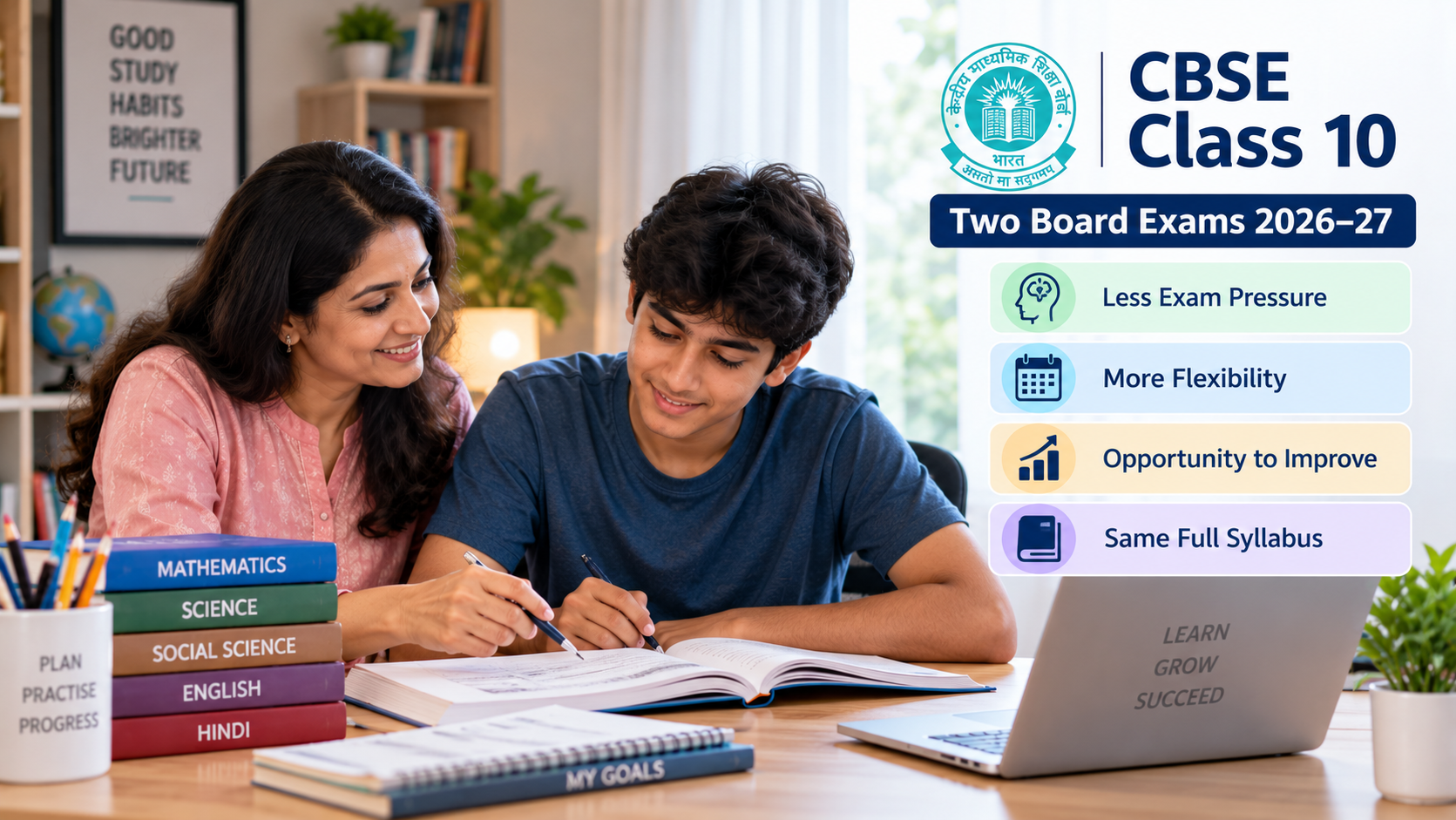
CBSE Class 10 board examinations have entered a new phase.
Starting with the 2026 examinations, the Central Board of Secondary Education
(CBSE) introduced two Board Examinations for Class 10 students in an effort
to provide greater flexibility and reduce the pressure associated with a
single high-stakes examination.
For parents and students preparing for the 2026–27 academic session,
understanding how the two-examination system works is important for planning
preparation, revision and examination strategy.
In this guide, we explain the CBSE Class 10 two-board-examination system,
what the first and second examinations mean, syllabus coverage, result
considerations and how students can prepare effectively.
CBSE has implemented two Board Examinations for Class 10 from the 2026
examinations. Students get a main examination opportunity and a second
examination opportunity under the conditions specified by CBSE.
What Are the Two CBSE Class 10 Board Examinations?
Under the new system, Class 10 students have the opportunity to appear for
two Board Examinations during the academic year.
CBSE introduced this reform in line with the National Education Policy (NEP)
2020, which recommended giving students more flexibility and reducing the
high-stakes nature of Board Examinations.
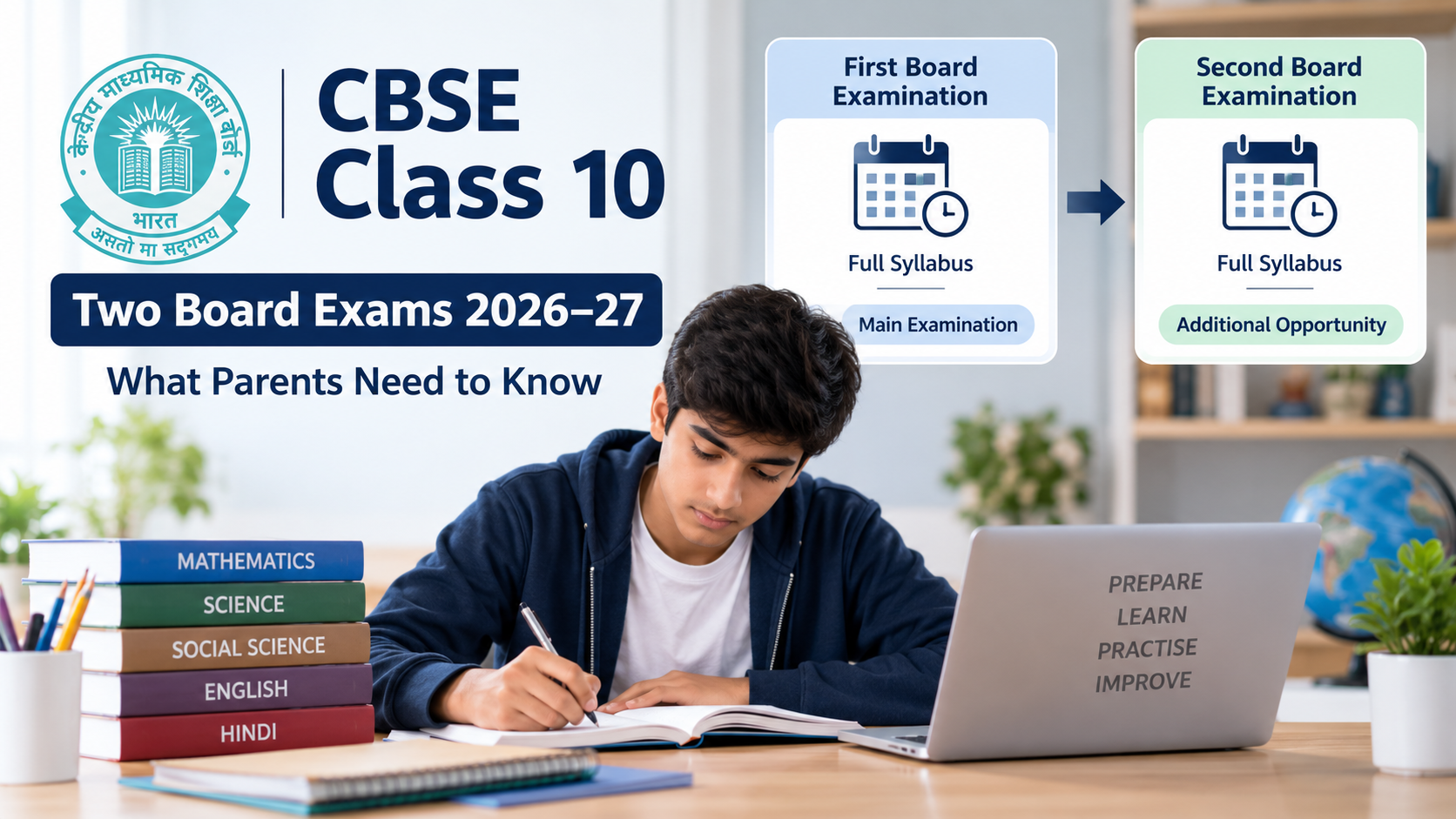
The two examinations are generally referred to as the
First Board Examination and the
Second Board Examination.
The second examination provides an additional opportunity according to the
rules and eligibility conditions prescribed by CBSE.
Parents should therefore understand that the second examination is not simply
a compulsory second attempt for every student. Students must follow the
eligibility, subject and application requirements issued by CBSE.
Read the official CBSE notification on Two Board Examinations for Class X
Why Has CBSE Introduced Two Board Exams?
Traditionally, Class 10 students faced significant academic pressure because
their Board Examination performance was concentrated into one major
examination period.
The two-examination approach is intended to make the assessment process more
flexible and student-friendly.
Key objectives include:
- Reducing examination-related pressure
- Giving students an additional opportunity to demonstrate their learning
- Reducing the high-stakes nature of a single examination
- Encouraging better preparation and academic planning
- Providing greater flexibility for students
CBSE’s official policy links the reform to the recommendations of
NEP 2020, which called for greater flexibility in Board
Examinations.
How Will the Two CBSE Class 10 Exams Work?
The two-examination structure does not mean that students receive two
completely different syllabi. CBSE’s scheme specifies that the examinations
are conducted using the full current syllabus and prescribed
textbooks.
| Feature | First Board Examination | Second Board Examination |
|---|---|---|
| Purpose | Main Board Examination | Additional opportunity under CBSE rules |
| Syllabus | Full current syllabus | Full current syllabus |
| Timing | First examination phase | Second examination phase |
| Preparation | Board-level preparation | Revision and improvement preparation |
| Eligibility | As per CBSE examination rules | Subject to CBSE eligibility and applicable conditions |
Is the Entire Syllabus Covered in Both Exams?
Yes. According to CBSE’s published scheme, both Class 10
Board Examinations are conducted on the full current syllabus and
prescribed textbooks.
This means students should not assume that they can prepare only selected
chapters for the second examination.
A strong understanding of the complete syllabus remains important for both
examination opportunities.
Can Students Appear for the Second Board Examination?
The second examination is designed to provide an additional opportunity,
but parents should not assume that every student can automatically appear
for every subject.
CBSE has specified eligibility and procedural requirements for the second
Board Examination. These include conditions relating to subjects,
registration and examination participation.
Parents should always check the latest CBSE notification issued for the
relevant examination year rather than relying on social-media posts or
unofficial explanations.
Does the Second Exam Mean Students Can Stop Preparing for the First Exam?
No.
Students should continue to treat the first Board Examination as their
primary examination opportunity and prepare seriously from the beginning
of the academic year.
The second examination should be viewed as an additional opportunity under
CBSE’s rules, not as a reason to postpone preparation.
Encourage your child to prepare for the first examination as the main goal.
The second examination should be considered a safety net or improvement
opportunity where applicable.
What Does This Change Mean for Parents?
The new examination structure changes the way parents should think about
Board preparation.
1. Avoid Last-Minute Preparation
Since both examinations are based on the full syllabus, students should
build their preparation steadily instead of waiting until the final weeks.
2. Focus on Understanding Concepts
Memorising answers alone may not be enough. Students should understand
concepts and practise applying them to different types of questions.
3. Practise Board-Level Questions
Students should regularly practise sample papers, previous-year questions,
competency-based questions and application-oriented problems.
4. Analyse Mistakes
Instead of simply completing more question papers, students should identify
recurring mistakes and work on the underlying concepts.
5. Build a Consistent Revision Plan
Regular revision throughout the academic year can make the transition from
classroom learning to Board preparation much smoother.
How Should Class 10 Students Prepare for the New CBSE Exam System?
- Understand the complete syllabus before starting intensive
Board preparation. - Create a subject-wise study plan based on strengths and
weaker areas. - Practise competency-based questions instead of relying
entirely on textbook memorisation. - Take regular mock tests under examination conditions.
- Review mistakes after every test and revise weak topics.
- Practise time management so that students can complete
papers comfortably within the examination duration. - Use the second examination strategically if the student
is eligible and needs the additional opportunity.
CBSE Class 10 Two Board Exams: What Parents Should Remember
| Question | Answer |
|---|---|
| Are there two Class 10 Board Examinations? | Yes. CBSE implemented the two-examination system from the 2026 examinations. |
| Is the second examination compulsory for every student? | No. Participation is subject to the applicable CBSE rules and conditions. |
| Is the full syllabus applicable? | Yes. CBSE’s scheme states that the examinations are based on the full current syllabus and textbooks. |
| Should students prepare seriously for the first examination? | Yes. Students should treat the first examination as their primary Board Examination. |
| Can students use the second examination as an additional opportunity? | Yes, where applicable under CBSE’s rules. |
How EduEnrich Global Can Help Class 10 Students
Changes in the examination system can create questions for both students
and parents. The most effective response is not simply studying for longer,
but studying with a clear strategy.
EduEnrich Global supports students with personalised
academic learning designed around their curriculum, grade level and
individual learning requirements.
Students can benefit from structured concept learning, regular practice,
doubt clarification, assessment and personalised academic support.
Explore CBSE Curriculum Support at EduEnrich Global
Parents can also explore our personalised learning approach to understand
how students can receive academic support based on their individual needs.
Learn More About Personalised Learning
Is Your Child Ready for the New CBSE Class 10 Exam System?
Help your child prepare with structured learning, concept clarity,
regular assessment and personalised academic support.
Frequently Asked Questions
1. When did CBSE introduce two Board Examinations for Class 10?
CBSE introduced the two Board Examination system for Class 10 from the
2026 examinations.
2. Are both Class 10 examinations based on the full syllabus?
Yes. CBSE’s published scheme states that both examinations are conducted
using the full current syllabus and prescribed textbooks.
3. Does every Class 10 student have to write both exams?
No. Students should follow the eligibility and participation conditions
specified by CBSE for the second examination.
4. Should students prepare differently because there are two exams?
Students should continue with comprehensive Board preparation. The second
examination should be treated as an additional opportunity where applicable,
rather than a reason to reduce preparation for the first examination.
5. Has CBSE reduced the Class 10 syllabus because of the two exams?
The two-examination system itself does not mean that students can prepare
only a reduced portion of the syllabus. CBSE’s scheme specifies that the
examinations are conducted on the full current syllabus.
6. Where can parents find official CBSE updates?
Parents should refer to the official CBSE website and examination circulars
for the latest rules, dates, eligibility requirements and examination
instructions.
Official CBSE Resources
CBSE Official Notification: Two Board Examinations in Class X
CBSE Examination Circulars
CBSE Previous Years’ Question Papers
CBSE Marking Schemes
Conclusion
The introduction of two Board Examinations marks an important change in the
CBSE Class 10 assessment system. For parents, the key message is simple:
the new system provides greater flexibility, but it does not remove
the need for consistent preparation.
Students should focus on understanding the complete syllabus, practising
different question types, improving conceptual clarity and taking regular
assessments.
With the right preparation strategy and timely academic support, students
can approach the new CBSE examination system with greater confidence.